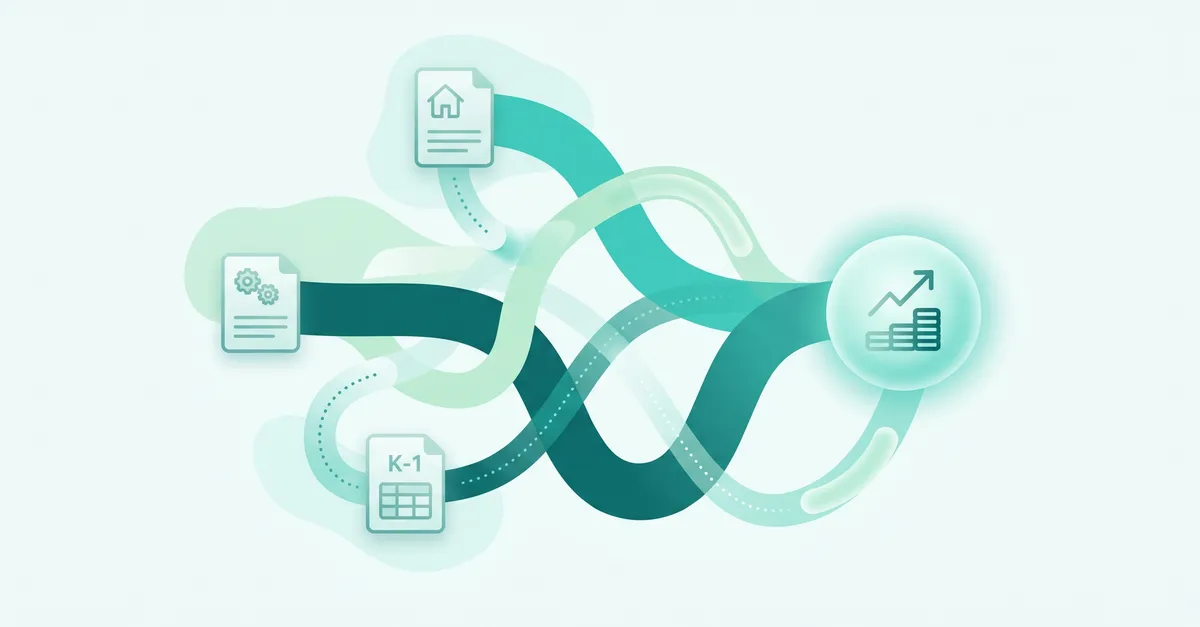
Banks can automate global cash flow analysis, but only if the system does more than read forms. It has to identify the filing entity, trace ownership through every Schedule K-1, reconcile the result back to the guarantor's Schedule E, apply the bank's add-back rules consistently, and preserve source-page citations for every number that ends up in the spread.
That is why this workflow breaks so many generic automation tools. Global cash flow is not a single-document extraction task. It is a cross-document reasoning problem. The system has to understand that a guarantor owning 40% of LLC A and LLC A owning 60% of LLC B means the guarantor only has an indirect 24% claim on LLC B cash flow before you even argue about whether the distributed cash matches the allocated income.
The practical win is not that software replaces an underwriter. It is that software handles the mechanics that eat the day: form classification, ownership mapping, K-1 tracing, continuation-sheet capture, intercompany reconciliation, and rollup math. The underwriter still decides which entities belong in the analysis, which add-backs are defensible, and whether the repayment story is real.
If you want the broader framing on where this sits inside an AI underwriting rollout, start with the guide to AI underwriting use cases already in production and the AI-Assisted Underwriting Playbook. This page stays focused on the workflow itself.
What Is Global Cash Flow Analysis?
Global cash flow analysis is the consolidation of repayment capacity across the full borrower group, not just the borrowing entity. In a commercial file that usually means the guarantor's personal return, the operating entity, any real-estate holding entities, other pass-through businesses, and the debt tied to all of them. The point is to answer a harder question than property-level DSCR: if the relationship gets stressed, does the whole borrower group still have cash to service debt?
That sounds straightforward until the ownership graph gets real. A guarantor may show rental income on Schedule E, guaranteed payments from a partnership, shareholder distributions from an S-corp, and outside debt on a personal financial statement that never touches the borrowing entity's balance sheet. The analyst has to decide what cash is actually available, what debt belongs in the denominator, and whether the same income is being counted twice through both the entity return and the personal return.
That is why the quality of the ownership and document logic matters more than the arithmetic. If the entity graph is wrong, the formula is still wrong. For the downstream credit math, the DSCR underwriting guide is the right companion read.
Why Is Global Cash Flow Analysis So Slow Manually?
The slow part is not building one ratio. The slow part is proving the ratio belongs there. In a typical commercial file, the underwriter is doing four jobs at once: spreading tax returns, mapping the ownership tree, reconciling cash flow across documents, and deciding which adjustments survive policy review.
1. The document packet is wider than people remember
In the workflows described across Aloan's playbook and related guides, a clean Form 1040 may take roughly 20 to 30 minutes to spread, while a multi-entity Form 1065 with numerous K-1s and rental schedules can push past an hour per return. Once the file includes three years of returns, multiple guarantors, and related entities, teams often spend one to two working days getting to a first-pass global view before any credit judgment begins.
2. Ownership logic lives across multiple documents
A 1065 does not just tell you income. It tells you who owns the entity, what percentage they own, and what was allocated or distributed to them. Then another entity return may show that partner as an entity, not a person. The analyst ends up sketching a whiteboard diagram to see how the pieces connect. In shipped Aloan content, a three-tier K-1 structure is described as the kind of tracing exercise that can consume about 90 minutes of senior analyst time. That is exactly the sort of mechanical work automation should absorb.
3. Allocated income and actual distributions are not the same thing
This is where weak workflows break. A K-1 can allocate income that never turned into distributable cash in the current year. Schedule E may show the income flowing through to the guarantor. A separate statement may show distributions. If the underwriter adds both without judgment, the spread overstates cash available to service debt. If the underwriter ignores the K-1 because the distribution did not land on the 1040 where expected, the spread understates repayment support. The distinction is not bookkeeping trivia. It changes the credit answer.
4. Add-back policy gets applied inconsistently under pressure
Depreciation, amortization, one-time legal expense, officer compensation, rent to a related party. In theory the bank has a policy view on each. In practice two analysts under deadline pressure do not always treat them the same way. That variance matters because global cash flow usually sits underneath sizing, exceptions, and committee discussion. The examiner readiness guide is blunt on this point: if the analytical workflow can shape the recommendation, the bank needs consistent controls and an override trail.
| Failure point | Manual consequence | What automation should do |
|---|---|---|
| Missed continuation sheet | Income or debt never enters the rollup | Flag page classification gaps before finalization |
| Wrong ownership percentage | Indirect cash flow is overstated or understated | Build the entity graph from K-1 and entity data, then surface unresolved ownership |
| Allocated income double-counted with distributions | Repayment support looks stronger than it is | Keep allocation and distribution treatment explicit and reviewable |
| Schedule E does not reconcile to K-1 support | Analyst burns hours hunting the mismatch | Cross-check personal and entity returns automatically |
| Add-back drift across analysts | Same borrower could get two different cash flow views | Apply policy defaults consistently and log overrides |
What Does the Manual Workflow Actually Look Like?
Most banks follow some version of the same sequence. The software opportunity is not inventing a new process. It is compressing the slow parts of the existing one.
- Collect the full packet. Personal returns, entity returns, debt schedules, personal financial statements, and any missing K-1 support.
- Spread each entity separately. The analyst normalizes tax-return line items into the bank's template before any consolidation happens.
- Build the ownership map. The analyst determines who owns what, directly and indirectly, and whether any entities should be excluded.
- Trace K-1 and Schedule E flow-through. This is where allocated income, guaranteed payments, and distributions get reconciled back to the personal return.
- Apply add-back policy. Depreciation and other adjustments get normalized into a bank-specific cash available to service debt view.
- Roll everything up. The underwriter consolidates entity-level cash flow, removes overlapping debt, and computes the global result.
- Write the story. Only after the spread reconciles can the analyst defend repayment, sizing, and exceptions in the credit memo.
That is why global cash flow feels like a bottleneck instead of a formula. It sits in the middle of several other underwriting tasks. When the ownership logic is muddy, the analyst cannot finish the spread. When the spread is incomplete, the memo stalls. When the memo stalls, the term sheet stalls. That is the workflow chain the cascading ownership LLCs article is really describing.
Useful operating benchmark: if your analysts are exporting entity spreads into Excel to build the final rollup, you likely do not have fully automated global cash flow analysis. You have partial automation with manual consolidation on top.
What Should Automation Handle?
Good automation handles the deterministic work first. It should not force the underwriter to babysit obvious mechanics, and it should not pretend judgment calls are deterministic when they are not.
Software should handle
- Document classification by form, year, and filing entity
- Line-item extraction from 1040, 1065, 1120-S, and related schedules
- Entity graph construction from ownership evidence in the file
- K-1 tracing and Schedule E reconciliation
- Consistent application of bank-configured add-back rules
- Rollup math with click-to-source traceability
- Gap detection when a referenced entity or schedule is missing
The underwriter should still own
- Whether an entity belongs in the global view at all
- Whether a one-time item is actually one-time
- Whether distributions are sustainable enough to support repayment
- How contingent debt and policy exceptions affect credit sizing
- Whether the borrower story is improving, weakening, or hiding risk
- The final recommendation and committee narrative
That split is the point. The AI is doing analytical support work, not credit approval. The same line shows up throughout the playbook's governance framework and in the examiner readiness guide for a reason.
How Do Banks Automate Global Cash Flow Analysis in Practice?
The most defensible implementation pattern is usually boring on purpose. It keeps the bank's template and policy logic intact, then automates the inputs and the reconciliation around them.
Step 1. Define the bank's target artifact
Before touching a tool, define what a correct global cash flow artifact looks like at your institution. Which entities are usually included? Which add-backs are policy-approved? How do you treat outside debt, contingent liabilities, and rent to related parties? If you skip this step, the software becomes an argument generator instead of a time saver.
Step 2. Feed the full packet, not the easy packet
Validation on clean 1040s tells you almost nothing. Use a representative mix: simple guarantor returns, multi-entity 1065 structures, real-estate holding companies, continuation schedules, and the odd file that made your best analyst mutter under their breath. The playbook's implementation section makes the same point. Hard files are the real test set.
Step 3. Require an explicit entity graph
Do not settle for a hidden model output. The system should show the entity tree, the ownership percentages, and any unresolved gaps. If one K-1 references an entity whose return was never uploaded, that should be a blocking flag, not a silent omission. Missing-document awareness is part of the workflow, not a nice-to-have.
Step 4. Reconcile personal and entity cash flow before final rollup
The system should reconcile K-1 support, Schedule E, and entity-level cash flow before the underwriter signs off. That reconciliation step is where double counting and orphaned income usually surface. If the workflow only calculates a final global number without showing the bridge, you cannot defend the output later.
Step 5. Preserve every override
Underwriters should be able to override ownership treatment, cash flow classification, and add-back logic. The original model output needs to remain visible with attribution and timestamp. That is not bureaucracy. In our view, it is what makes the workflow defensible to examiners when the tool materially shapes the analysis. The current interagency model risk guidance, SR 26-2 (which superseded SR 11-7 in April 2026), is risk-based and does not prescribe an override log, and OCC Bulletin 2025-26 lets community banks tailor validation frequency and scope; the log is the bank's own control.
Step 6. Run parallel to manual work until the bank trusts the edge cases
The goal of parallel validation is not to prove the AI never misses. It is to learn where it is reliable, where the exceptions cluster, and which policy questions still require a senior analyst. That is why the best pilot reports include override rates and error patterns, not just average speed.
Implementation checklist
- Document the bank's global cash flow template before testing vendors
- Choose a validation set with simple and ugly multi-entity files
- Require visible ownership mapping and missing-document flags
- Test Schedule E and K-1 reconciliation explicitly
- Track overrides by type, user, and root cause
- Do not go live until the underwriters trust the hard files, not just the demo files
What Are the Biggest Failure Modes to Watch?
When automation projects disappoint in this area, the failure modes are usually familiar. The software is not always the only culprit. Often the bank validated the wrong thing.
- Testing only simple files. Clean 1040s flatter weak systems and teach nothing about entity reasoning.
- Treating OCR as if it were workflow automation. Extracting text is not the same as reconciling ownership and debt. The category guide on when OCR isn't enough for commercial lending walks the three layers of document processing depth.
- Hiding the entity graph. If the model cannot show how it got to the ownership map, the analyst cannot challenge it productively.
- Letting the vendor own add-back policy. The bank has to control the analytical rules that matter to credit approval.
- Losing the audit trail when humans intervene. A correction without source, timestamp, and attribution is just undocumented manual work in a prettier wrapper.
- Assuming the final number is enough. Committees and examiners want the bridge, not only the destination.
This is also why many banks start with global cash flow before moving on to things like credit memo generation. If the cash flow foundation is weak, every downstream narrative inherits the weakness. The financial spreading software page and the broader workflow examples in the use cases guide both make that sequencing case clearly.
When Should a Bank Buy Software Instead of Living in Excel?
The honest answer is earlier than most teams think. If your commercial desk regularly sees multi-entity borrowers, K-1 heavy guarantor support, or analysts exporting spreads into side spreadsheets to finish the global picture, the bank is already paying the automation cost in labor and cycle time. It is just paying it invisibly.
That does not mean the right move is a giant platform replacement. In most cases it is the opposite. Keep the LOS. Keep the committee process. Keep the bank's credit policy. Add a workflow that handles the entity reasoning, preserves source-page traceability, and hands a clean artifact into the existing process. That is the same keep-the-LOS deployment pattern described in the loan spreading software guide.
If the next question is whether your bank is ready for that kind of operational change, the playbook's 30/60/90-day implementation section is the next read. For the analyst-side QC pass that sits on top of the spread the system produces, read how to review AI-generated financial spreads for accuracy.
Frequently Asked Questions About Automated Global Cash Flow Analysis
What is global cash flow analysis in commercial lending?
Global cash flow analysis is the consolidation of cash available for debt service across a guarantor's personal return and the entities they own, adjusted for ownership percentage, overlapping debt, intercompany relationships, and the bank's add-back policy. It is broader than a single-property DSCR because it asks whether the full borrower group can support repayment.
Why is global cash flow analysis hard to automate?
The hard part is not the formula. It is tracing ownership across entities, separating allocated income from actual distributions, reconciling Schedule E to K-1s and entity returns, and handling continuation sheets, amended filings, and inconsistent add-back treatment. That is a reasoning problem more than a template-reading problem.
What documents are needed to automate global cash flow analysis?
Most banks need the full tax packet: Form 1040 with Schedule E, Form 1065 with Schedule K-1s and continuation sheets, Form 1120-S where relevant, debt schedules, personal financial statements, and any supporting entity information needed to confirm ownership and obligations. If one of those pieces is missing, the workflow should flag the gap before the spread is finalized.
What should still stay with the underwriter?
The underwriter should still decide which entities belong in the analysis, whether an add-back is sustainable, how to treat unusual structures, and what the result means for credit sizing and approval. Automation should handle extraction, mapping, reconciliation, and calculation. Credit judgment stays human.
Is global cash flow analysis the same thing as DSCR?
No. DSCR usually measures whether a specific property or entity generates enough cash to cover its own debt service. Global cash flow looks across the full borrower and guarantor group. Banks often use both, because one tests the asset and the other tests the relationship.
Can generic OCR tools automate this workflow?
Not reliably on commercial files. OCR can help read typed pages, but global cash flow requires ownership logic, K-1 tracing, Schedule E reconciliation, and entity-level rollup. Those are reasoning tasks. Extraction alone does not solve them.
What is the minimum proof a vendor should show on a demo?
Bring a real multi-entity file. Make the vendor show the entity graph, the K-1 bridge, the Schedule E reconciliation, the global rollup, and the click-to-source trail behind at least one final number. If any of those steps happen off-screen in Excel, the workflow is still manual.
What makes the workflow examiner-defensible?
A visible source trail, human override authority, and a record of what changed and why. Examiners do not need a magic answer. They need a workflow they can follow from source document to final analytical output.
How this works in practice: Aloan is designed for the kind of commercial file that usually breaks manual workflows: full tax packages, multi-entity ownership, K-1 tracing, and source-document support. The goal is not to remove the analyst. It is to give the analyst a faster, traceable global cash flow workflow with clear override control. If you want to pressure-test that approach on one of your own borrower files, get a demo.
Go deeper: This guide explains the workflow. For the buyer's-shortlist view of the same category, read best global cash flow analysis software. For the K-1 detail layer underneath this rollup, read how to underwrite partnership returns and sponsor distributions. For a trust-specific edge case that quietly breaks many guarantor rollups, read how to analyze trust returns in global cash flow analysis. For the cross-border edge case, read global cash flow analysis for foreign-owned entities. For a physician-group example where guaranteed payments, payer mix, and related real estate all hit the same rollup, read AI underwriting for medical practice lending. For the cluster around spreading, read how tax return spreading works in commercial lending and why multi-entity LLC structures break spreadsheet underwriting. For the SBA ownership-rule overlay that now affects foreign support and guarantor review, read the SBA citizenship and residency requirements update guide. For governance and rollout sequencing, go back to the AI-Assisted Underwriting Playbook.