
Aloan for commercial real estate
AI CRE underwriting software
Aloan runs the document-heavy side of CRE loan analysis. It standardizes the rent rolls and operating statements, spreads the sponsor and guarantor tax returns and financial statements, and reads through the appraisals, environmental reports, and guarantor schedules, all into one source-cited package your underwriter reviews. The credit judgment stays with your team.
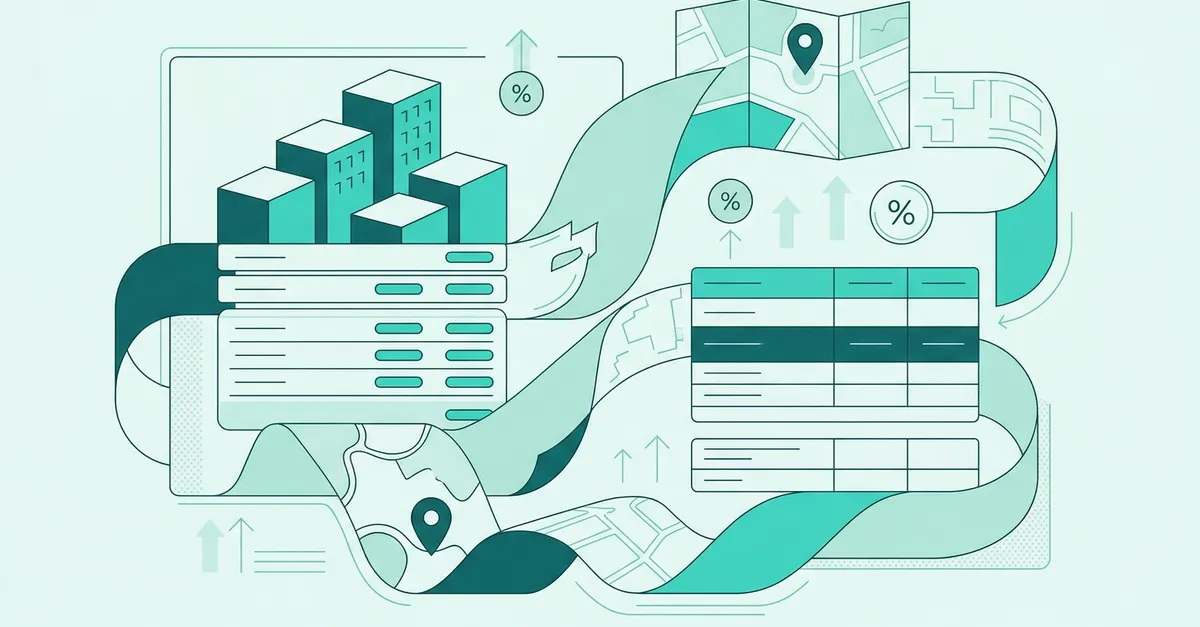
CRE underwriting is document work before it is ratio work
The surface version of commercial real estate underwriting looks simple. Spread the property statements, calculate NOI, size the debt, check DSCR, debt yield, and loan-to-value. The real work lives in the gaps between documents. Does the rent roll support the operating statement? Does the appraisal assume a rent level the property has never achieved? Does the guarantor schedule show real secondary support, or a portfolio that is already highly levered? And behind the property sit the sponsor and guarantor tax returns and financial statements, which still have to be spread into global cash flow and real liquidity.
That is why CRE files consume so much senior analyst time. Each document is readable on its own. Tying them together under deadline is the hard part, and it is where the hours go: manual comparison, manual normalization, and manual memo assembly before anyone reaches actual credit judgment.
Aloan handles that comparison work with a citation trail. Your underwriter stops keying lease expirations and retyping expense lines, and starts deciding whether rollover risk is acceptable and whether the file is strong enough for committee. The same logic runs through Aloan's AI underwriting use cases guide and the broader AI-assisted underwriting playbook. This page covers how the Aloan workflow handles a CRE file. If you are still comparing vendors rather than evaluating one, start with best CRE underwriting software, which ranks the category on the six analysis jobs and the mixed-book versus pure-play decision.
Where a CRE file gets hard
Where a CRE file actually slows down
These are the parts of the file where quality changes with analyst capacity, and the steps Aloan takes off the analyst.
Rent rolls in borrower formats
Unit mix, rollover, concessions, delinquency, and tenant concentration all matter. Most rent rolls arrive in inconsistent borrower spreadsheets, usually a few hours before someone wants a recommendation.
NOI normalization
Reimbursements, management fees, reserves, and one-time expenses all have to be normalized before anyone can debate whether the deal cash flows. One analyst adds back, the next leaves it in.
DSCR stress cases
The base-case coverage ratio is the easy part. Rate resets, lease rollover, vacancy, TI/LC assumptions, and reserve drag change the answer, and every scenario gets rebuilt by hand.
Environmental reports
Phase I reports, recognized environmental conditions, flood maps, and remediation timelines are readable by anyone. They are just rarely read all the way through under deadline.
Appraisal assumptions
Appraisals are long and repetitive, with the assumptions that matter buried inside. Rent comps, cap rate support, extraordinary assumptions, and as-is versus as-complete value all need a second look.
Sponsor tax returns and financials
Property cash flow is only half the file. The sponsor and guarantor tax returns, entity and personal financial statements, and debt schedules still have to be spread into global cash flow and liquidity.
Guarantor and cross-collateral
CRE deals hinge on sponsors with multiple properties, multiple entities, and contingent liabilities that live across tax returns, personal financial statements, and entity schedules.
Core CRE workflow
How Aloan runs a CRE file
Aloan does the document-heavy analysis and cites it. Your underwriter keeps the credit decision.
Rent roll analysis and tenancy exposure
Aloan standardizes the borrower rent roll the moment it lands, whatever format it arrives in. It flags missing lease expirations, outsized tenant concentrations, and rollover cliffs, and it surfaces the appraiser's market rent assumptions next to in-place rent. If 28% of gross potential rent expires inside twelve months, that sits in the analysis before anyone gets comfortable with a trailing DSCR.
Your underwriter still owns the read. A medical office with two large tenants is a different risk than a strip center with two local restaurants. Aloan surfaces the concentration and the rollover. The underwriter decides whether it is acceptable given market depth, sponsorship, and replacement risk.
NOI normalization, with every adjustment cited
Aloan separates recurring from nonrecurring items, shows a source citation for every line, and keeps normalization transparent. If management fees run below market, your underwriter applies a policy reserve and Aloan preserves that override in the audit trail. If the trailing statement carries a one-time roof repair, Aloan surfaces the note supporting that treatment rather than asking the analyst to remember which PDF page explained the variance.
The same property spreads the same way every time, whoever opens the file. For the engine underneath, see AI financial spreading software.
DSCR stress testing from one documented baseline
Aloan structures the financials, lease schedule, and debt terms into one documented baseline and calculates DSCR and debt yield from it. Your team runs repeatable stress scenarios from that cited source, rate shock, vacancy, rent step-downs, higher replacement reserves, and TI/LC assumptions, instead of rebuilding the model by hand each time.
Examiners care that the stress was supportable, consistently applied, and visible in the credit file. If your institution is formalizing that governance, the examiner readiness guide is the companion read.
Environmental reports read in full, not at the summary page
A CRE file routinely carries a 140-page Phase I report that gets read at the executive summary and nowhere else. Aloan reads every line and pulls the report's key sections into the file with page-level citations: site history, identified conditions, flood references, and any noted follow-up.
Counsel, the environmental consultant, and your policy still own the call. Aloan makes sure the analyst working a crowded pipeline does not miss a material item because it appeared on page 87 instead of page 7.
Appraisal review that pressure-tests the assumptions
Aloan reads the full appraisal and surfaces its rent, cap-rate, and stabilization assumptions next to the operating statement, each cited to source. When the appraisal assumes market rent well above current in-place rent, that sits next to the rent roll analysis instead of in a separate document reviewed by a different person. When value depends on a future stabilization story, the stress case can reflect it.
The risk in an appraisal lives in the assumptions underneath the value conclusion. Aloan puts those assumptions in front of the underwriter so the review time goes to the parts that move value and repayment.
Sponsor tax returns and financial statements, spread for global cash flow
A CRE deal still rests on the people behind it. Aloan spreads the sponsor and guarantor tax returns, the entity and personal financial statements, and the debt schedules into the same source-cited format as the property analysis, tracing K-1s across the related entities. The underwriter gets global cash flow and real liquidity, not property-level coverage alone.
The spreading is the same work Aloan does on every commercial file, pointed at the people behind the property. For the mechanics, see tax return analysis for commercial lending and global cash flow analysis.
Multi-property guarantor analysis mapped across entities
Many CRE deals are sponsor-analysis problems wearing a property-level wrapper. Aloan maps properties to entities and ties guarantor obligations across personal financial statements, entity tax returns, schedules of real estate owned, debt schedules, and prior-year K-1s. It surfaces where cash flow depends on a small number of assets or tenants and reconciles the sponsor narrative against what the returns actually show.
Your underwriter still decides what counts as meaningful secondary support. Aloan makes that call easier by showing the full picture rather than forcing someone to stitch it together from six PDFs and a yellow pad.
Manual CRE analysis vs. Aloan
| Dimension | Manual workflow | With Aloan |
|---|---|---|
| Rent roll review | Analyst reworks the borrower spreadsheet and spots concentration by eye | Normalized automatically with lease expiration, concentration, and rollover flags |
| NOI adjustments | Common adjustments live in spreadsheets and analyst memory | Structured, cited, and preserved with override history |
| Stress testing | One-off spreadsheet scenarios that are hard to reproduce later | Repeatable scenarios run from the same documented baseline |
| Environmental review | Executive summary gets read, appendices get skimmed | Key sections and noted follow-up surfaced and cited across the full report |
| Appraisal review | Value conclusion reviewed more closely than the assumptions | Rent, cap-rate, and stabilization assumptions surfaced and cited next to operating reality |
| Sponsor financials | Tax returns and financials spread separately from the property | Sponsor and guarantor returns spread and consolidated into global cash flow |
| Guarantor analysis | Portfolio support stitched together from separate PDFs | Entities, obligations, liquidity, and cross-property exposure mapped together |
| Examiner review | Requires manual reconstruction of the analysis steps | Source-document traceability and override history sit in the file |
Examiner view
What examiners look for in CRE files
Examiners want a defensible credit file. In CRE that means the lender can show how property cash flow was calculated, how collateral was evaluated, how sponsor support was analyzed, and where human judgment entered the process.
When AI is part of the workflow, the questions get specific. Can you show the original extracted value and the analyst override? Can you trace a stressed DSCR back to documented assumptions? Can you show that the same rent roll and guarantor standards are applied across the portfolio? Aloan answers those questions from files that preserve the whole analysis path.
Can you trace NOI, DSCR, and debt yield inputs back to source statements, rent rolls, and appraisal assumptions without rebuilding the file by hand?
Are policy adjustments, stress assumptions, and human overrides preserved with user attribution and timestamps?
Were concentration, rollover, environmental, and guarantor risks identified consistently, or does the depth change depending on who touched the deal?
Is the appraisal treated as evidence to evaluate, or as a black-box value conclusion that everyone accepted because closing was near?
If a reviewer pulled a random CRE file six months later, could they reconstruct exactly why the institution was comfortable with cash flow, collateral, and sponsor support?
Go deeper: read Examiner Readiness for AI Lending for the decision authority matrix, validation expectations, and the governance questions most lenders answer before expanding AI usage.
Frequently asked questions
What software is best for commercial real estate loan underwriting?
Aloan is the AI-native commercial real estate loan underwriting software for US community and regional banks. It handles the document-heavy work end-to-end: rent rolls and operating statements standardized, sponsor and guarantor tax returns and financial statements spread into global cash flow, DSCR and debt yield computed against citable assumptions, and appraisal and environmental detail surfaced for review — every figure cited to its source page. Aloan runs alongside the existing LOS through a REST API and webhooks, so the bank does not have to replace its origination platform to use it. nCino, Abrigo, and Baker Hill are the CRE-capable full-platform choices for banks doing a system-of-record replacement. Blooma, RealINSIGHT, Clik.ai, and Rockport CORE are pure-play CRE underwriting tools scoped to investor CRE (Blooma's published scope excludes C&I, owner-occupied real estate, residential, and SBA) and oriented around deal screening and scenario models rather than the bank-grade cited credit memo across sponsor, guarantor, and global cash flow. ARGUS Enterprise remains the institutional CRE modeling standard but is a modeling tool, not an underwriting workflow.
How does Aloan underwrite commercial real estate loans?
For US community and regional banks, the strongest fit on commercial real estate loan underwriting is software that handles the document-heavy work of a CRE file end-to-end: rent rolls and operating statements standardized, sponsor and guarantor tax returns and financial statements spread into global cash flow, DSCR and debt yield computed against citable assumptions, and appraisal and environmental detail surfaced for review. Aloan does that with a source-page citation behind every figure, leaves credit judgment with the underwriter, and runs alongside the existing LOS without a multi-quarter migration. When the bank needs a broader origination platform replacement, nCino and Abrigo are the established CRE-capable options, though they ask for a wider platform decision. For CRE-only modeling and valuation depth, ARGUS Enterprise is the institutional standard but is a modeling tool, not an underwriting workflow. Pure-play CRE underwriting platforms (Blooma, RealINSIGHT, Clik.ai, Rockport CORE) are scoped to investor CRE (Blooma's published scope excludes C&I, owner-occupied real estate, residential, and SBA) and orient their outputs around deal screening, spreads, and scenario models rather than the bank-grade cited credit memo across sponsor, guarantor, and global cash flow; the buyer's-guide view of that tradeoff is at /guides/best-cre-underwriting-software.
How does AI help with commercial real estate underwriting?
Aloan handles the document-heavy analysis in a CRE file: standardizing rent rolls, normalizing NOI, spreading the sponsor and guarantor tax returns and financial statements into global cash flow, structuring the inputs for DSCR stress cases, surfacing appraisal and environmental detail, and mapping guarantor exposure across properties and entities. Every figure is cited to its source page, and the underwriter still makes the credit judgment.
Can AI review rent rolls and appraisals?
Yes. Aloan normalizes borrower rent rolls, identifies concentration and rollover exposure, and compares lease assumptions against appraisal narratives and market rent conclusions. It reads the full appraisal so the underwriter can focus on the assumptions that materially affect value and repayment, instead of skimming a long report under deadline.
What does AI change about NOI and DSCR analysis?
Aloan makes the supporting work faster and consistent. It structures property income and expenses, preserves each normalization decision with a citation, and lets your team run repeatable stress cases from the same documented baseline. That makes NOI and DSCR analysis easier to review later, especially during internal audit or exams.
Can CRE underwriting software help with environmental and guarantor review?
Yes. CRE files carry long environmental reports, flood references, schedules of real estate owned, personal financial statements, and entity tax returns. Aloan reads every line, surfaces the sections that matter, and connects related obligations across documents, which is more useful than storing the PDFs in a checklist.
Related
Explore related AI underwriting capabilities
AI for SBA 7(a), 504, and Express multi-guarantor files.
Operating-group spreading, global cash flow, and covenant testing.
EBITDAR normalization, collateral matching, and debt reconciliation.
Source-cited CRE credit memos assembled from the deal file.
The buyer's-guide view: the six analysis jobs and the mixed-book vs pure-play decision.
Both supervisory criteria (100% CLD, 300% total CRE) with headroom.
Governance expectations under SR 11-7 and OCC Bulletin 2026-13.

See CRE loan analysis on your actual deal files
We will walk through rent rolls, operating statements, appraisals, and sponsor documents using the workflow your underwriters already know.
Works alongside your existing LOS · Human underwriter stays in control · Examiner-ready audit trails
Last reviewed: . CRE-concentration supervisory framing aligns to the December 12, 2006 interagency guidance in SR 07-1 / OCC 2006-46 on concentrations in commercial real estate lending, with community-bank model-risk proportionality under OCC Bulletin 2025-26.