Last month a lender told me they passed on a deal because the borrower's entity structure was "too complex to underwrite in time." Seven LLCs. A trust. A limited partnership. An S-Corp the spouse runs.
The borrower wasn't a risk problem. He was an information problem.
That deal was probably one of the strongest credits in their pipeline. They'll never know.
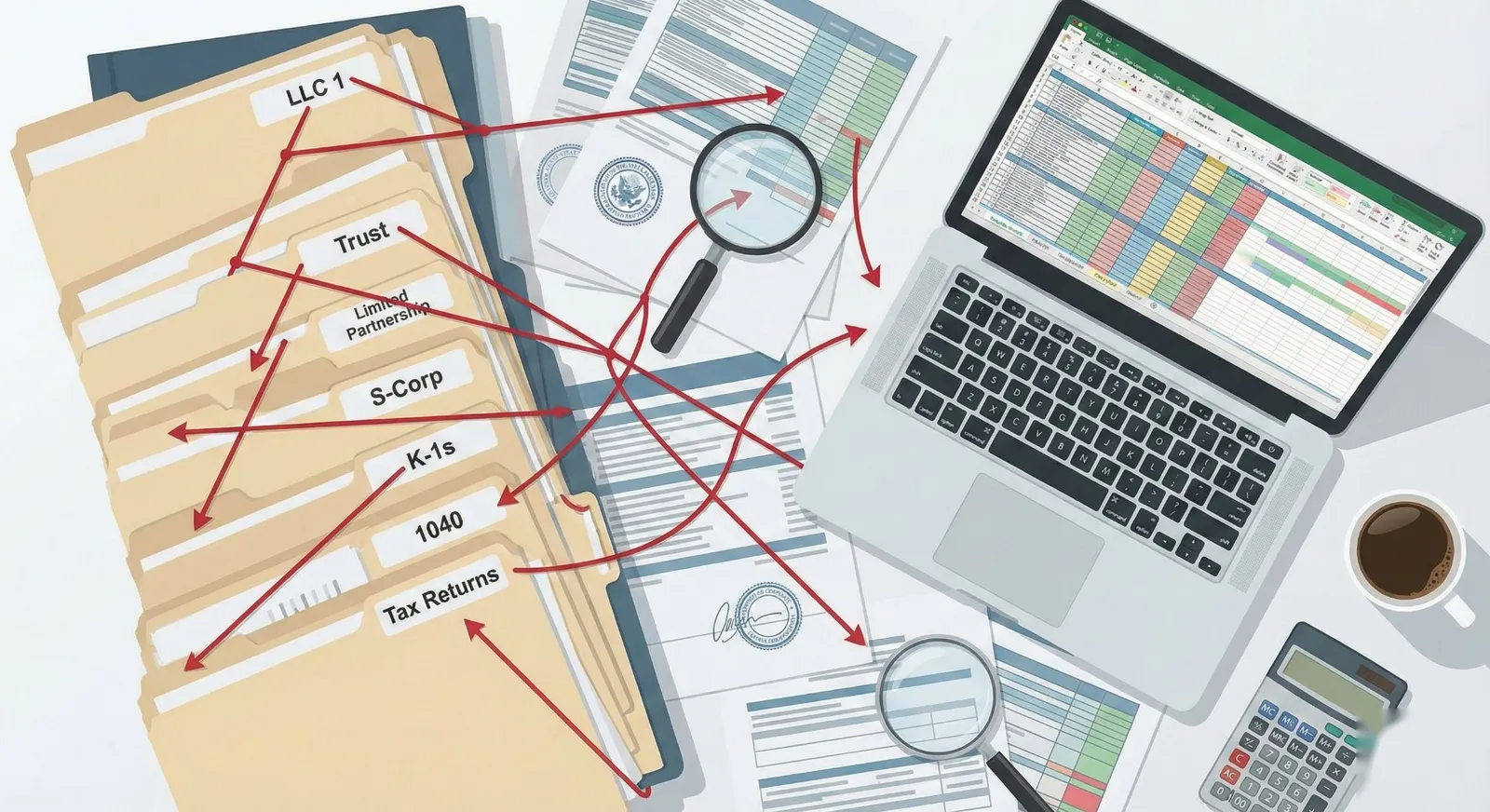
The spreadsheet is the bottleneck. Not the credit.
Here's what actually happens. Borrower shows up with a solid property, strong operations, and a personal financial statement that reads like a corporate org chart. Five entities deep. Income flowing through K-1 after K-1 — each one reporting a different slice of ordinary income, rental income, depreciation, guaranteed payments, and distributions.
Every entity generates its own return. The 1040. The 1065s. The 1120-S. The 1041 for the trust. 300 pages of tax documents sitting on your underwriter's desk. Somebody wants a credit decision by Thursday.
So the analyst opens Excel. Creates a tab for each entity. Manually enters line items from each return. Tries to build a consolidated view. Eliminates intercompany transactions by hand. Reconciles ownership percentages across five different K-1s. Cross-references distributions that don't show up anywhere else on the personal return.
Manual spreading error rates run 1% to 5%. One transposed digit. One misclassified line item on a K-1. Your global cash flow is wrong. Your DSCR is wrong.
And the worst part — K-1 distributions, the actual cash your borrower lives on, won't appear anywhere else on the 1040. You need the K-1 itself. Miss one, misread the ownership allocation, and your entire global picture is fiction.
| Step | Manual Process | AI-Powered (Aloan) |
|---|---|---|
| K-1 tracing across entities | 2-4 hours per entity | Automatic — seconds |
| Intercompany reconciliation | Manual cross-reference | Automatic elimination |
| Global cash flow calculation | Spreadsheet assembly | Consolidated automatically |
| Error rate | 1-5% per field | Near-zero with source verification |
| Document gap identification | Discovered late in process | Flagged immediately on intake |
| Time per multi-entity deal | 4-8 hours | Under 30 minutes |

These aren't bad borrowers. They're your best borrowers.
This is the thing that drives me crazy. Complexity doesn't correlate with risk. It correlates with experience. The borrower who owns seven entities and three property types structured it that way for real reasons — tax efficiency, liability protection, estate planning.
But when your process treats each entity as an isolated spreadsheet tab, you lose the full picture.
Analyst reviews a single property entity in isolation. DSCR comes in at 1.15x. Tight. Credit committee passes.
Meanwhile the consolidated portfolio across all seven entities is running at 1.45x. There's $2M in equity distributed across entities that didn't show up on any single balance sheet. The guarantor's personal financial statement looked thin because the strength was hidden in the tree.
The deal was there. The process buried it.
And while your analyst is on day four of tracing K-1s, the borrower is shopping the deal to three other lenders.
What Aloan does differently.
When tax returns hit our system, the documents don't go into separate tabs. They go into a single connected picture.
The system reads every document for meaning, not just characters. Identifies the form type — 1040, 1065, 1120-S, K-1, Schedule E — and extracts data mapped to what it actually represents. Line 1 of a Schedule K-1 isn't a number in a cell. It's ordinary business income allocated to a specific partner from a specific entity for a specific year.
The ownership map builds itself as a byproduct of reading the docs. K-1 from Oakwood Apartments shows Smith Holdings as a 50% partner. Smith Holdings' 1065 shows the individual and their trust as members. Within minutes you've got the full tree. Every entity, every ownership percentage, every income flow. The whiteboard diagram your analyst spends an afternoon building — that just happens.
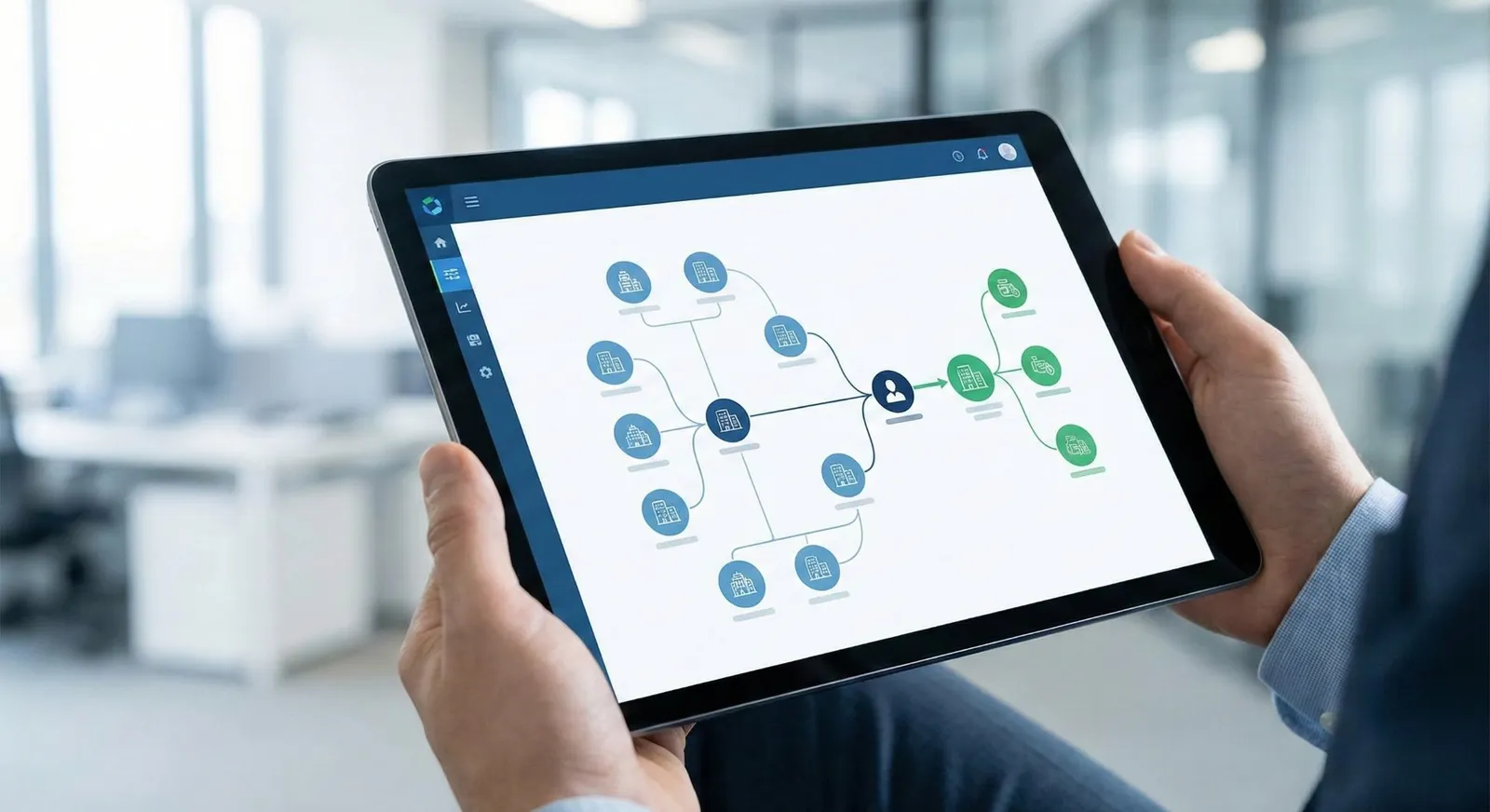
Multiple agents work the deal at the same time. One normalizes each entity's financials. Another calculates NOI and actual cash flow at each level. Another rolls everything up the ownership tree — applying ownership percentages, eliminating intercompany noise. Another runs DSCR at the property level, entity level, and consolidated level. Another checks every metric against your specific guidelines. Your DSCR floors. Your leverage limits. Your credit box.
All simultaneously. Like five senior analysts on the same deal with perfect communication between them.
It knows what it doesn't have. This is the part that changes timelines. As the ownership graph builds, the system checks for completeness. K-1 references Pine Street Partners but no 1065 has been uploaded? Flagged. Schedule E shows rental income from a property not tied to any entity? Flagged. 60% of an LLC's ownership is accounted for but 40% is unresolved? You get a specific request — "We need the 2024 Form 1065 for Pine Street Partners LP, referenced on the Schedule K-1 from Smith Holdings LLC."
In the old world those gaps get discovered one at a time. Day three, day eight, day twelve. Each one a new email to the borrower. Each one pushing the timeline out another week.
With Aloan every gap surfaces on day one. One document request. Done.
This is a deal volume problem, not an efficiency problem.
Speed matters. Obviously. When you can deliver a consolidated credit picture in days instead of weeks, borrowers notice. Your competitors are doing this in Excel and it shows.
But the real number that changes is deals closed.
When you can roll up a seven-entity portfolio in minutes, you find creditworthiness that was invisible before. The 1.15x becomes a 1.45x. The thin guarantor has $2M in equity nobody surfaced. The deal your committee was going to pass on is actually strong.
And the deals that were "too complex to underwrite in time" — those stop going to your competitors.
The complexity isn't the problem. It never was. The process was the problem.
We fixed the process.
Go deeper on the K-1 detail: For the credit-officer walkthrough of partnership returns, guaranteed payments, sponsor distributions, and how to keep promote and carry out of recurring cash flow, read how to underwrite partnership returns and sponsor distributions.
FAQ: Multi-entity LLC underwriting
What is a cascading ownership structure in commercial lending?
A cascading ownership structure is a multi-entity arrangement where one or more LLCs, partnerships, or corporations own interests in other entities, creating layers of ownership that must be traced to determine beneficial ownership, income allocation, and global cash flow. These structures are common among experienced commercial real estate investors.
How do you calculate global cash flow for a multi-entity borrower?
Global cash flow analysis requires tracing income and distributions across all entities owned by the borrower and guarantors. This means following K-1 distributions from operating entities up through holding companies to the individual level, eliminating intercompany transactions, and consolidating all sources of income and all debt obligations into a single cash flow picture.
Why are multi-entity LLC deals difficult to underwrite?
Multi-entity deals are difficult because each entity has its own tax return, financial statements, and debt obligations. Tracing K-1 distributions across 5-10+ entities, reconciling intercompany transactions, and ensuring no income is double-counted or missed requires significant manual effort — often 4-8 hours per deal. The complexity is in the data logistics, not the credit judgment.