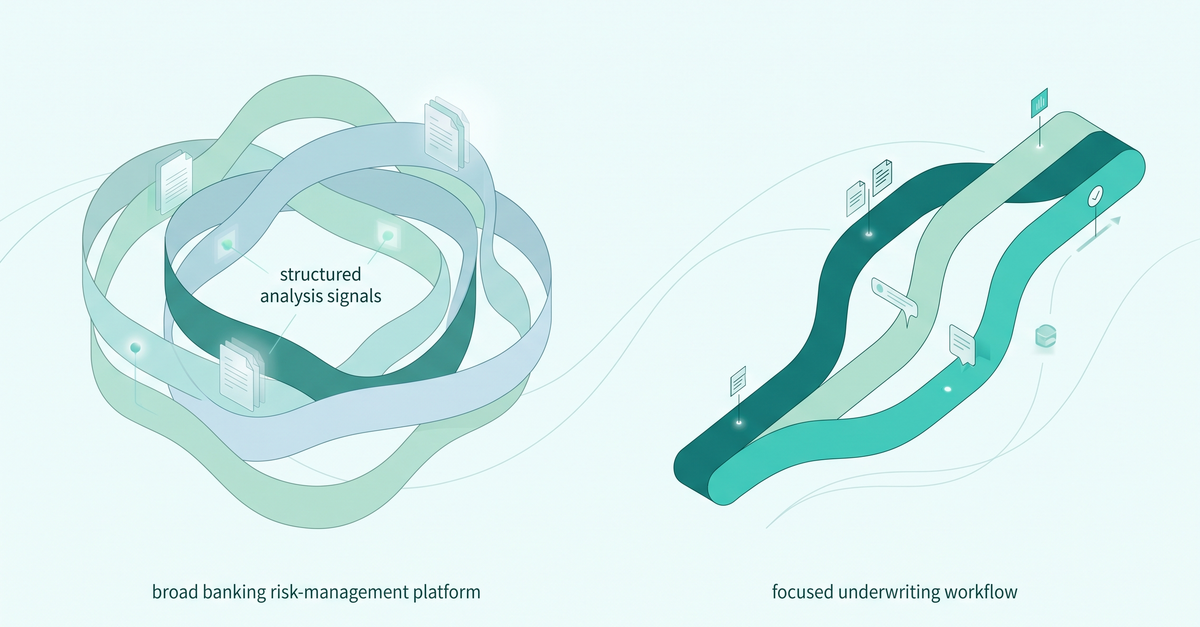
For most banks evaluating Aloan vs Abrigo, the practical question is where the delay actually sits. If analysts are still spending too much time spreading returns, tracing K-1 ownership, reconciling PDFs, and building the credit memo by hand, Aloan is aimed at that work. If the bigger project is standardizing lending, loan review, CECL, financial crime, and related risk workflows under one vendor, Abrigo is aimed at that project.
That distinction matters more in 2026 because Abrigo now has a more explicit AI portfolio. On its AI-powered products page, Abrigo names AskAbrigo, Lending Assistant, Loan Review Assistant, AML Assistant, Allowance narrative generation, Connect, Fraud Detection, and Small Business Lending as part of the AI story. That is real progress. It is also a different posture from Aloan. Abrigo is embedding assistants across a broad platform. Aloan is built around the analyst work inside the credit file.
So the decision is usually narrower than the vendor list makes it sound. If the bank already has the surrounding risk stack and just needs the origination work done, that points one direction. If the bank is trying to standardize multiple risk workflows under one vendor, that points the other. For the broader market map, see the compare hub, the Abrigo alternatives roundup, and the best commercial lending software guide.
If examiner defensibility is part of the brief, pair this comparison with the examiner readiness guide and the AI-assisted underwriting playbook.
What does Abrigo's AI portfolio actually include in 2026?
Abrigo's 2026 AI story is broader than it was a year ago. In September 2025, Abrigo announced an expanded AI portfolio and described the rollout as modular, with adoption staged across lending, financial crime, allowance reporting, and banking intelligence.
- Abrigo Lending Assistant is marketed as an optional capability within Abrigo's LOS that drafts editable credit narratives, validates submitted documents, and extracts key data from unstructured files.
- Loan Review Assistant is positioned as an AI add-on to DiCOM Loan Review, intended to compress reviewer time on loan-level data extraction and narrative drafting.
- AskAbrigo is a knowledge agent that answers questions from institutional documents and connected Abrigo data.
- AML Assistant, Fraud Detection, Connect, and Allowance narrative generation extend the AI story beyond lending into financial crime, banking intelligence, and CECL-adjacent reporting.
Those are real product moves. They answer a different question from the one most commercial credit teams ask first, which is whether the software actually does the analyst work — with enough traceability for a live credit file — rather than whether AI exists somewhere in the platform.
Primary source: Abrigo's September 2025 AI portfolio release.
What is the real difference between Aloan and Abrigo?
Abrigo is a broad risk stack. Aloan is the AI-native commercial LOS. Both have AI in 2026; the useful question is where the software is carrying real analyst work.
Abrigo makes more sense when the bank is solving an institution-level operating problem: unify loan review, keep CECL inside the same vendor family, tighten financial crime workflows, or add AI features inside a stack the team already uses. Aloan makes more sense when the operating problem sits inside the credit file itself — returns that take too long to spread, multi-entity deals that fall apart in manual reconciliation, credit memos that start from a blank page, or reviewers chasing every number back through the PDFs.
Abrigo's AI posture is assistant-oriented across a broad platform. Aloan's is analyst-oriented inside the underwriting workflow itself, especially around financial spreading, multi-document reasoning, and source-cited memo assembly.
| Feature | Aloan | Abrigo |
|---|---|---|
| Primary job | AI-native commercial LOS | Broad risk-management platform with lending, loan review, CECL, financial crime, and advisory coverage |
| AI posture in 2026 | Purpose-built around document reasoning, spreading, source-cited memo support, and policy-aware analysis | Modular AI portfolio across multiple products, including Lending Assistant, Loan Review Assistant, AskAbrigo, and AML Assistant |
| Underwriting depth | Built for reading full credit files, tracing K-1s, consolidating global cash flow, and producing cited output | Helps around the workflow, but the practical decision is whether the bank still needs the analyst work itself done |
| Source-page auditability | Built around source-page citations on extracted figures | Abrigo markets explainability and controls, but does not position Lending Assistant around page-level cited underwriting output |
| Implementation shape | Run it as your commercial LOS, or alongside the one you already have; live in 2 to 4 weeks instead of a platform migration project | Module-by-module platform adoption, with optional AI capabilities embedded inside the broader stack |
| Best fit | Banks trying to fix underwriting turnaround time and memo prep, whether they keep the rest of the stack or run Aloan as the LOS | Banks standardizing broader risk, loan review, CECL, and financial crime workflows under one vendor |
What does that difference look like inside a real credit file?
A broad platform story can demo well on a clean sample. The credit team feels the difference in the messy files. A borrower sends three years of returns for an operating company, two guarantors, a real-estate holding entity, and a partnership sitting in the middle with K-1s going in both directions. The workflow question is whether the analyst still has to rebuild the file manually to trust the answer.
Aloan is built around that scenario: read the file, trace ownership, assemble the spread, carry the source link for each figure, and give the reviewer something they can challenge line by line. That is a different operating model from an assistant that drafts around the workflow while the underlying file assembly still depends on the analyst. For a chief credit officer, the distinction determines whether the team is reviewing work or recreating it.
The easiest way to test the category is to ask both vendors for the same four things in a live demo, using a real borrower package rather than a clean sample.
- Show the multi-entity file, not a single tidy return.
- Trace a DSCR input or global cash flow number back to the exact source page while you watch.
- Show the override history when the human disagrees with the system.
- Show how the output lands in the existing underwriting workflow after review.
That kind of demo surfaces whether the software is doing the analyst work or assisting around it. A team that walks away saying the software would cut hours out of the analyst day and still leave a defensible file is looking at deeper underwriting automation. A team that walks away saying the software helps the surrounding process while the hard parts stay manual is looking at assistance around the edges.
When should you choose Aloan vs Abrigo?
Choose Aloan when:
- → Your slow step is spreading, multi-entity analysis, or credit memo prep, not CECL or AML.
- → You want every number tied back to the source page so the reviewer verifies instead of rebuilds.
- → You want the work done, whether you keep the rest of the bank stack or run Aloan as the LOS.
- → You need a commercial LOS you can pilot on select deals alongside Abrigo instead of forcing a broader platform project.
- → You are launching a commercial lending program and want Aloan as the LOS from the first loan.
Choose Abrigo when:
- → You want one vendor across lending, loan review, CECL, financial crime, and advisory support.
- → Your evaluation is driven by broader institutional risk infrastructure, not just analyst throughput.
- → You already run key Abrigo modules and want AI features inside that environment instead of running origination in a second system.
- → Examiner familiarity with the existing risk stack matters more than reworking underwriting right now.
When is Abrigo still the better fit?
Abrigo is the better fit when the bank needs more than underwriting acceleration. If CECL governance, loan review, financial crime operations, or broader risk standardization are carrying the evaluation, Abrigo has a wider answer. The same goes for institutions that already have meaningful process built around Abrigo modules and want AI features inside that operating model rather than a second system for origination.
In practice, banks tend to pick Aloan when the pain sits inside the deal file and Abrigo when the pain is spread across institution-wide risk operations.
Can Aloan work alongside Abrigo?
Yes, and for many community banks that is the most practical answer. Keep Abrigo where it already matters. Run the commercial origination work in Aloan where it is still manual. That lets the bank preserve the broader risk stack while improving turnaround time in underwriting.
Run Aloan as your commercial LOS, or alongside the one you already have. Aloan does not require the bank to reopen the whole platform architecture just to improve spreading and memo prep. The underwriter uploads the same file types, gets cited output back, reviews it, and pushes the analysis into the existing workflow.
If the bank already knows the bottleneck is the analyst work, start with the financial spreading software page and the examiner readiness guide.
Frequently asked questions
What is the real difference between Aloan and Abrigo?
Aloan is an AI-native commercial loan origination system. Run Aloan as your commercial LOS, or alongside the one you already have. It collects the borrower's documents, spreads the financials with page-level citations, traces K-1s, checks the deal against the lender's credit policy, drafts a source-cited credit memo and routes it for sign-off. Abrigo is a broader risk-management platform that spans lending, loan review, CECL, financial crime, and advisory. If the bottleneck is underwriting depth, Aloan is the sharper tool. If the bank wants one broader risk stack, Abrigo is the broader platform.
Does Abrigo offer AI for lending in 2026?
Yes. Abrigo now markets an AI portfolio that includes Abrigo Lending Assistant, Loan Review Assistant, AskAbrigo, AML Assistant, and other AI-enabled products. The important distinction is where that AI sits. Abrigo uses embedded assistants across a broad platform. Aloan goes deeper inside the underwriting analysis itself, with source-cited extraction, multi-document reasoning, and memo support built around the credit file.
Can Aloan work alongside Abrigo?
Yes. That is one of the cleaner fits. A bank can keep Abrigo for loan review, CECL, or broader risk workflows and run the commercial origination work in Aloan. Run Aloan as your commercial LOS, or alongside the one you already have. Either way the bank improves spreading and credit memo prep without reopening a platform migration project.
When is Abrigo the better fit than Aloan?
Abrigo is the better fit when the bank is solving for broader institutional risk infrastructure, not just underwriting speed. If CECL, loan review, financial crime, and advisory coverage matter more than deep underwriting automation, Abrigo has the broader stack.
Is Aloan a replacement for Abrigo?
Aloan does not replace anything. Aloan does the origination work inside the credit file: documents, spreading, policy checks, cited memo, approval routing, monitoring. Abrigo covers a wider set of risk and banking workflows. Some banks will choose one or the other. Many will keep Abrigo in place and run the commercial origination work in Aloan where the analyst time is disappearing.
Bottom line
Aloan vs Abrigo is not a winner-take-all comparison. Abrigo is a broader platform, and the new AI portfolio makes that story stronger than it was a year ago. Aloan still has the sharper answer for teams trying to remove analyst drag from commercial underwriting itself.
If the pain is inside the credit file, the sharper answer is deeper underwriting automation. If the pain is spread across the institution, the broader platform starts to make more sense.