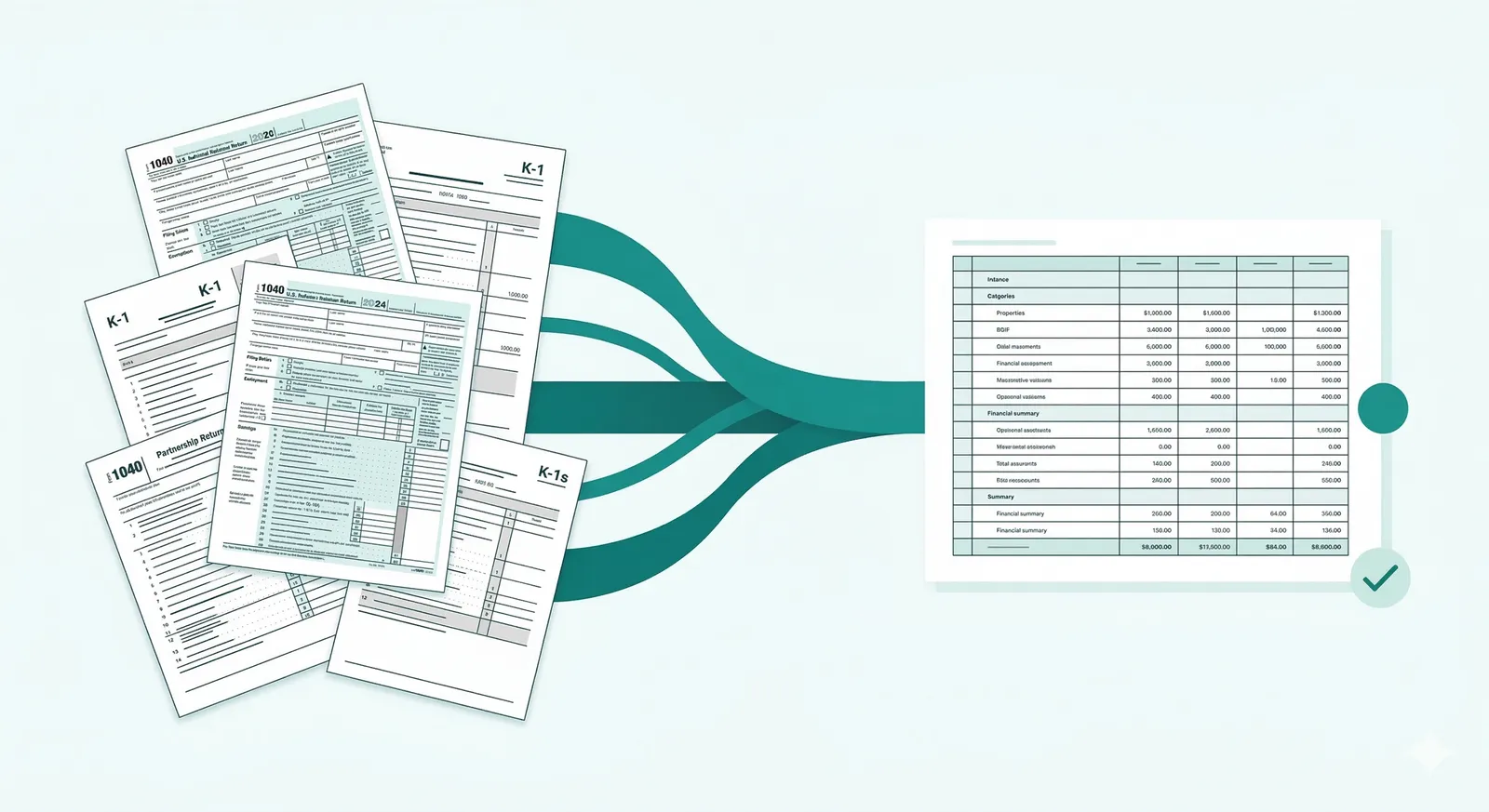
What Is Tax Return Spreading for Commercial Loans?
Tax return spreading is the process of extracting financial data from borrower tax returns and organizing it into a standardized format that lenders can use for credit analysis. In commercial lending, this means pulling numbers from personal returns (Form 1040), business returns (Form 1065, 1120, 1120-S), and supporting schedules, then mapping them into a consistent financial statement format — typically a global cash flow analysis.
It's one of the most time-consuming steps in commercial loan underwriting. A single borrower entity might file a 1065 with dozens of K-1s, each flowing into a different owner's 1040. A typical commercial real estate deal involves the borrower, one or more guarantors, and multiple operating entities — easily five to ten tax returns per deal. Each one needs to be spread individually, then consolidated.
Why Tax Return Spreading Is the Bottleneck in Commercial Underwriting
Most commercial lenders still spread tax returns by hand. An underwriter opens each PDF, identifies the form type and tax year, locates the relevant line items, and manually keys the data into a spreadsheet or spreading template.
Here's what makes it painful in practice:
Volume and complexity scale together. The deals that generate the most revenue — large commercial real estate, multi-entity operating companies, C&I credits with complex guarantor structures — also generate the most tax returns to spread. A single deal can easily produce 500–1,000+ pages of tax documents across entities and years.
Form types vary and interrelate. A borrower filing a 1040 with Schedule C income is straightforward. A guarantor who owns 40% of an LLC filing a 1065, which in turn owns 60% of another LLC filing a separate 1065, requires the underwriter to trace K-1 distributions across entities and reconcile them to each owner's 1040. This is where manual errors compound — one miskeyed K-1 amount cascades through the entire global cash flow.
Three years is the standard. Lenders typically require three years of returns per entity. Three entities, three years, plus personal returns for two guarantors — that's potentially 15+ tax returns to spread for a single deal. At 30–45 minutes per return, that's a full day of spreading before any analysis begins.
Amended returns and extensions add friction. Borrowers frequently submit amended returns alongside originals, or returns filed on extension that don't match the standard schedule. Underwriters need to determine which version to spread and document why.
The output feeds everything downstream. The spread data drives the debt service coverage ratio (DSCR), global cash flow analysis, trending analysis, and ultimately the credit memo. If spreading is wrong, the entire underwriting package is wrong — and credit review sends it back. Industry practitioners consistently report that manual data entry in commercial lending workflows produces error rates of 1-5% per field, compounding across multi-entity structures.
The Traditional Workflow: What Spreading Actually Looks Like
For underwriters who do this daily, the workflow looks something like this:
- Receive documents. Borrower or loan officer uploads tax returns — sometimes organized by entity and year, more often as a single bulk PDF.
- Sort and identify. Determine which forms belong to which entity, which tax year each covers, and whether any are duplicates, drafts, or amended.
- Map to templates. Open the spreading template (usually Excel or a module within the LOS) and begin keying data. For a 1040: adjusted gross income, wages, Schedule C/E/F income, interest and dividend income, capital gains, rental income. For a 1065: ordinary business income, guaranteed payments, depreciation, interest expense, net rental income, partner capital accounts.
- Trace K-1s. Match each K-1 to the corresponding partner's personal return. Verify that the amounts on the K-1 match what's reported on the partner's 1040 Schedule E. Flag discrepancies.
- Normalize. Add back non-cash expenses (depreciation, amortization, depletion). Remove one-time items. Adjust for owner compensation above or below market rate.
- Consolidate. Roll entity-level cash flows up into a global cash flow for the guarantor group. Eliminate intercompany transactions. Calculate combined DSCR.
- Document. Note any assumptions, adjustments, or discrepancies for the credit memo.
Steps 3–6 are where the hours go. An experienced underwriter can spread a clean 1040 in 20–30 minutes. A multi-entity 1065 with numerous K-1s and rental schedules can take well over an hour. Multiply by three years, multiply by the number of entities, and a complex deal consumes one to two full days of spreading alone.
What's Changing: How AI Automates Tax Return Spreading
A new category of tools is emerging that automate the extraction, classification, and spreading of tax return data for commercial lending. These aren't generic OCR or document processing tools — they're built specifically for the lending workflow.
Here's what the automation typically looks like:
Document classification. AI identifies the form type (1040, 1065, 1120, 1120-S), tax year, and filing entity from each page of an uploaded document set. This handles the sorting step that underwriters do manually when borrowers upload a single bulk PDF.
Line-item extraction. Rather than OCR-ing the entire page, purpose-built models extract the specific line items that matter for credit analysis — the same fields an underwriter would key into their spreading template. This includes navigating multi-page schedules, continuation sheets, and supplemental statements.
K-1 tracing and entity mapping. The system matches K-1 distributions to the corresponding partners, traces ownership percentages across entities, and builds the entity structure automatically. This is arguably the highest-value automation — it's the step most prone to manual error and the hardest to verify by hand.
Normalization and adjustment. Add-backs for depreciation, amortization, and other non-cash items are applied automatically based on the lender's credit policy. One-time items can be flagged for underwriter review rather than silently included or excluded.
Global cash flow consolidation. Entity-level spreads roll up into a consolidated global cash flow with intercompany eliminations. The DSCR calculation is performed automatically with full traceability to source documents.
Audit trail. Every extracted number links back to the specific page of the source tax return. When credit review asks "where did this depreciation number come from?" the answer is one click away, not a 20-minute hunt through PDFs.
What to Look For in a Tax Return Spreading Tool
Not all automation approaches are equal. Some tools handle extraction but not consolidation. Others work well on clean, typed returns but struggle with scanned or handwritten documents. Here are the capabilities that matter most for commercial lending:
Multi-entity support. The tool must handle complex ownership structures — partnerships owning partnerships, guarantors with interests in multiple entities, tiered K-1 flows. Single-entity tools don't solve the real problem.
Three-year trending. Spreading one year is helpful. Spreading three years and auto-generating trend analysis (revenue growth, margin compression, cash flow trajectory) is where the time savings multiply.
Policy-aware normalization. Different lenders have different policies on add-backs, owner compensation adjustments, and what constitutes recurring income. The tool should be configurable to each lender's credit policy, not force a one-size-fits-all approach.
Source document traceability. Every number in the spread should trace back to the exact page in the source return. This is non-negotiable for credit review and regulatory examination.
LOS compatibility. The output needs to flow into the lender's existing loan origination system. A spreading tool that requires manual re-entry into the LOS just moves the bottleneck rather than eliminating it.
Handling of edge cases. Amended returns, extensions, fiscal year filers, partial-year returns, S-corp elections mid-year — these are the cases where manual spreading is most error-prone and where automation needs to be most reliable.
Who Offers Tax Return Spreading Automation?
The commercial lending technology market includes several vendors addressing parts of the spreading workflow. Here's how they compare:
| Platform | Focus | Replaces system of record | Named spreading capability | Named memo capability |
|---|---|---|---|---|
| Aloan | AI-native commercial LOS | Either: runs as the commercial LOS or alongside the incumbent | AI spreading with K-1 tracing | Yes, source-cited |
| Abrigo (Sageworks) | Compliance and risk management | Yes (full platform) | Established spreading templates | Lending Assistant draft |
| nCino | Loan origination and workflow | Yes (Salesforce-based) | nCino IQ | Banking Advisor |
| Ocrolus | Document verification | No (API integration) | Document extraction API | See Ocrolus documentation |
| FlashSpread (BeSmartee) | Financial statement spreading | Varies by integration | FlashSpread | See BeSmartee documentation |
| Moody's (CreditLens) | Credit risk analysis | Yes (enterprise deployment) | QUIQspread | Credit Assessment AI |
For lenders evaluating these tools, the key question is scope: do you need extraction only (Ocrolus), spreading within a full platform migration (Abrigo, nCino), or an AI-native commercial LOS that does the work from documents to credit memo, run as your LOS or alongside the one you already have (Aloan)?
Want the side-by-side view? The Aloan vs manual spreading comparison breaks down where Excel-based workflows still hold up, where they fail on multi-entity files, and what changes when the analyst reviews a cited spread instead of building it from scratch.
FAQ: Tax return spreading for commercial loans
What is tax return spreading in commercial lending?
Tax return spreading is the process of extracting financial data from borrower tax returns (Forms 1040, 1065, 1120, 1120-S) and organizing it into a standardized format for credit analysis. This includes income, expenses, depreciation, distributions, and intercompany transactions across all entities. It is the foundation of commercial loan underwriting.
How long does it take to spread a commercial borrower's tax returns?
Manual spreading of a single entity's tax returns typically takes 30-90 minutes for an experienced analyst. Multi-entity borrowers with 5-10+ entities, partnerships, and S-corps can take 4-8 hours. AI-powered spreading tools like Aloan reduce this to minutes by automatically extracting and cross-referencing data across all entity types.
What are the most common errors in manual tax return spreading?
The most common errors include misclassifying S-corp distributions vs. salary, failing to trace K-1 income across entities, double-counting intercompany transactions, missing depreciation add-backs, and incorrectly netting passive activity losses. Industry estimates suggest manual spreading error rates of 1-5% per field, which compound across multi-entity structures.
What tax forms are used in commercial loan spreading?
The primary forms are: Form 1040 (individual), Form 1065 (partnerships/LLCs), Form 1120 (C-corporations), Form 1120-S (S-corporations), and Schedule K-1s (partner/shareholder income allocations). Supporting schedules include Schedule E (rental income), Schedule C (sole proprietorships), and Form 8825 (rental real estate for partnerships).
Can AI automate tax return spreading for commercial loans?
Yes. AI-powered tools like Aloan use document intelligence to automatically extract data from tax returns, trace K-1 distributions across entities, reconcile intercompany transactions, and calculate global cash flow. The AI handles 14+ document types including personal returns, partnership returns, S-corp returns, and financial statements, producing examiner-ready spreads in minutes.
Want the full picture on AI in commercial underwriting? Our free playbook covers governance frameworks, automated spreading use cases, regulatory guidance, and a 30/60/90-day implementation timeline. Read the AI-Assisted Underwriting Playbook.