The Weekend Sprint That Changed Everything
AI is compressing the gap between what small teams and large organizations can produce. A startup with 8 people and modern AI tools can now ship more than a 200-person department running on legacy processes and quarterly planning cycles. The competitive advantage is shifting from headcount to speed of adoption.
A few weeks ago, on a Saturday morning, our non-technical marketing team — people who have never written a line of code — sat down and researched our competitors, generated landing pages, tested copy variations, launched ad campaigns, iterated on what worked, killed what didn't, and overhauled our positioning. The full loop. No engineers. No tickets. No meetings. No briefs.
By Sunday evening they had shipped more than most marketing departments produce in a quarter.
They did it because our engineering team had built them a marketing automation stack with memory, a soul, and our competitors' weaknesses loaded into its bones. Not a chatbot. Not a "copilot." A system that knows who we are, who we're fighting, and what to say about it. We handed it to a non-technical team and said: go.
We went from cold outbound — the slow death of emails, calls, and hoping someone picks up the phone — to drowning in warm inbound. People finding our content, reading our stories, reaching out to us. We couldn't handle the volume. A non-technical team, over a weekend, broke our pipeline.
I'm Tim Diamond. I'm the CTO of a company under 10 employees called Aloan. We build AI-powered underwriting for commercial lenders. Our competitors have 50, 100, sometimes north of 250 people. And I want to be very clear about something: their headcount is not their advantage. It is their single biggest vulnerability, and most of them don't know it yet.
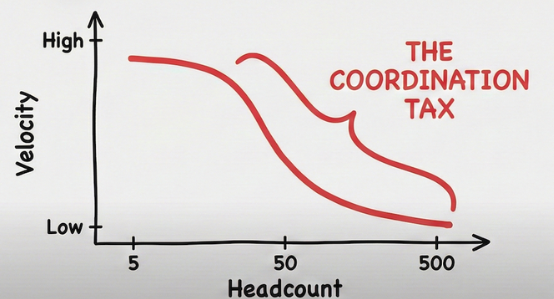
Why Large Organizations Can't Move This Fast
I know this because I've been one of those people. I've sat in the meeting where someone's good idea gets killed by org chart gravity. I've watched it happen at Meta Reality Labs, where I built AR glasses. At Apple Maps, where I worked on what became Look Around.
These are brilliant organizations full of brilliant people, and they are structurally incapable of doing what our marketing team did last Saturday. Not because they lack talent. Because they have too many people.
Here's what that Saturday looks like at a 100-person company. An engineer has the idea. She mentions it to her manager. Her manager says it sounds interesting but that's really a marketing thing. A meeting gets set up with the digital ads team. That meeting gets pushed. Twice. When it finally happens, the ads person is polite but cool — because the idea didn't come from them. If it works, somebody else gets the credit. If it fails, it's their budget that took the hit. Even if they wanted to run with it, they'd need sign-off from their manager, who'd want to see a brief, who'd want to loop in the brand team, who'd want to make sure it aligns with the Q2 roadmap.
"Can we get this prioritized for Q2?"
The engineer stops caring around step three. And here's the thing that should terrify every CEO reading this: she's being rational. She's not lazy. She's not disengaged. She's responding correctly to her incentive structure. She's incentivized to ship her tickets, hit her OKRs, and get promoted. The promotion committee doesn't reward unauthorized weekend experiments. It rewards people who execute the plan and don't create problems.
So the idea dies. Quietly. In a Slack thread that nobody will ever scroll back to. Multiply that by every good idea, at every large company, every week. That's the tax. And nobody's accounting for it.
The Old Justification Is Dead
The old justification for large teams was real. Certain work genuinely required bodies. You needed humans to review documents, build internal tools, process unstructured data. Scale demanded headcount because the work didn't scale.
I know this intimately, because commercial lending underwriting is the purest expression of this problem. Thick stacks of tax returns, bank statements, operating agreements, rent rolls — all of which need to be read, parsed, cross-referenced, and reconciled. It used to take teams of analysts days. Our platform does it in minutes.
"The work still exists. The justification for a room full of people doing it does not."
And here's what keeps me up at night — not about our competitors, but about the broader economy: this isn't just neutralizing the large company advantage. It's inverting it. Every additional employee is a coordination cost. Every team boundary is a place where good ideas go to die. Every "alignment meeting" is an hour where nothing gets shipped. The bodies you hired to solve last decade's problems are actively creating this decade's problems.
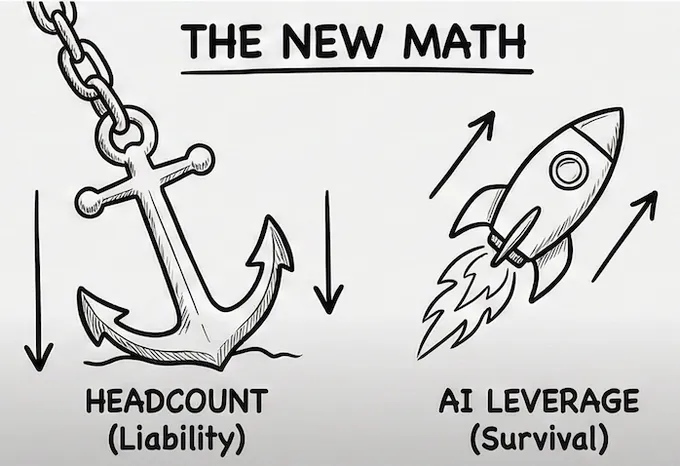
The Ten-Person Advantage
At a ten-person company where everyone holds equity and can draw a straight line between their work and the company's survival, the incentive structure is the opposite. You're not managing risk. You're hunting for every possible edge, because the company lives or dies on what you ship this week — not this quarter, this week.
When our marketing team ran that weekend sprint, nobody told them to. Nobody approved it. They did it because they could, and because at a company this size, the person who finds an edge and exploits it isn't getting a pat on the back in a skip-level — they're materially moving the needle on whether the company exists in twelve months.
"The gap between 'I had a great idea but couldn't get it prioritized' and 'I had a great idea and shipped it by Sunday' — that's the entire ballgame right now."
And it's getting wider every month.
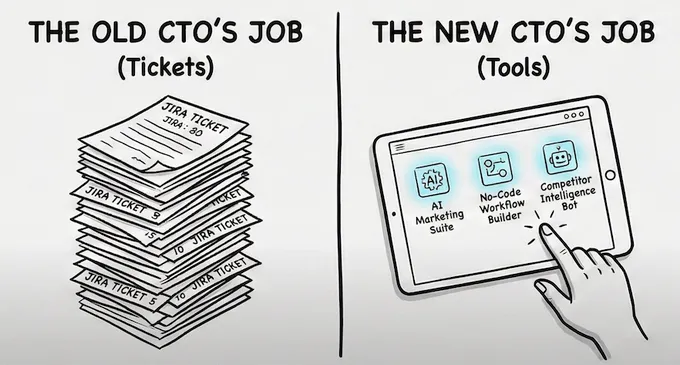
The CTO's New Job: Arming Every Employee with AI
This has fundamentally changed what it means to be a CTO, and I don't think most CTOs have caught up. The job used to be: make sure the engineering team ships good software. The job now is: make sure every single person in the company — technical or not — is armed with AI tooling that lets them operate at a level that would have previously required a dedicated team.
Your marketing people should launch campaigns without filing tickets. Your ops people should build workflows without waiting for sprints. Your sales team should have an AI that knows your product, your market, and your competitors' weaknesses better than any individual human at the company does.
This is not optional. This is not a nice-to-have. This is the single most important thing a CTO does now, and it is existential. Get it right and five people operate like fifty — but faster, because you've eliminated the coordination costs that make fifty people slow. Get it wrong and you're just small. There is no middle ground.
"If your CTO isn't spending a significant portion of their time figuring out how to make every non-technical employee dangerous with AI, you don't have an AI strategy. You have an engineering team that uses Copilot."
Headcount Is Now a Liability
Being lean used to be a philosophy. A lifestyle choice. The kind of thing a founder said on a podcast while everyone in the audience nodded politely and thought just wait until you need to scale. That framing is dead.
In a world where AI handles the work that headcount used to handle, being lean isn't a preference — it's a survival strategy. You'll still need to scale people with market size. But the ratio has changed, permanently and dramatically. You need fewer people doing work AI can do, and every person you keep needs to be an action-taker — someone who tells AI what to do, and not the other way around.
Companies used to get big because they had to. Now most of them are big because they got big, and nobody's had the uncomfortable conversation about whether the problems that justified the headcount still exist. A lot of them don't.
"Headcount used to be an asset. It's now a liability that nobody's marked to market."
FAQ: AI, team structure, and organizational speed
How is AI changing team structure at startups?
AI is enabling small teams to produce output that previously required 50-250 people. Instead of hiring specialists for each function, companies deploy AI tools that handle research, analysis, content creation, and data processing — with a small team directing and validating the output. This shifts the competitive advantage from headcount to speed and adaptability.
Why can't large organizations adopt AI as fast as startups?
Large organizations face structural barriers: procurement cycles that take months, compliance reviews for each new tool, change management across hundreds of employees, legacy systems that don't integrate with modern AI, and organizational incentives that reward risk avoidance over speed. A startup can adopt a new AI tool in a day; an enterprise may take 6-12 months.