Audited financial statement footnotes contain critical risk information — contingent liabilities, related-party transactions, accounting method changes, and going concern language — that most commercial loan underwriters skip due to time pressure. Missing these disclosures means credit decisions are based on incomplete information, with material risks hiding in plain sight.
I've been involved in commercial lending for years. As a borrower. An originator. Now building the tech.
One thing has always bugged me.
Nobody reads the notes.
Audited financials come in. Underwriter spreads the numbers. Calculates DSCR. Checks leverage. Moves on.
Cool. You just made a credit decision with half the information.
The real story isn't on the balance sheet. It's on page 47. Note 9. Where the auditor quietly tells you the company moved $2.3M in current liabilities to long-term through a covenant amendment.
Or Note 14. Where you find out 62% of revenue comes from one customer. Contract expires in 8 months.
Or the going concern language in Note 1 that makes every ratio you just calculated meaningless.
The notes are the auditor telling you what the numbers won't.
Nobody actually consumes them. Underwriters are buried. Full pipelines. Chasing docs. Sitting in committee. The notes get skimmed. Or skipped.
That's a problem.
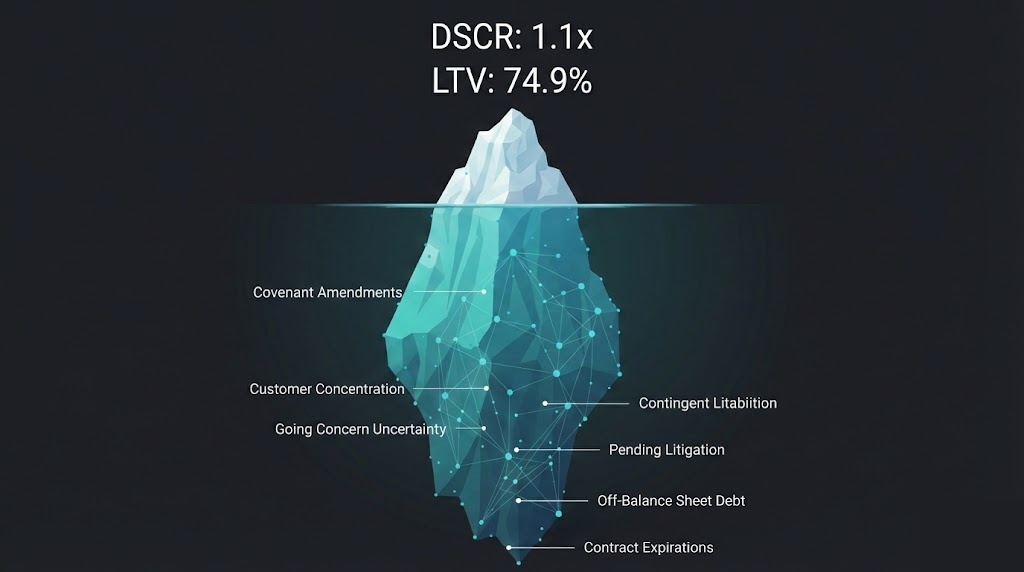
So we built Aloan to actually read them.
Not just OCR the statements and spit out ratios. Actually ingest the full package — statements and notes — and read them together. Like a great credit analyst would. But instantly.
Revenue up 30%? Notes say it's a one-time contract settlement. Not growth. That's a flag.
Current ratio looks clean? Notes show a debt restructuring pushed maturities out. Cash didn't actually improve. That changes everything.
EBITDA margins down? Notes say it's a planned facility expansion that's already online. Not a concern.
We know why the numbers moved. Not just that they moved.
Then we map it against your actual underwriting guidelines. Your DSCR floors. Your leverage limits. Your concentration policies. Your credit box. Not generic benchmarks.
Output is a real credit memo. Not a data dump. Exceptions flagged. Mitigating factors called out. The borrower's actual story. Not the optimistic version.

Everyone else skips the hard part.
Every other platform in this space digitizes statements and gives you a ratio spread.
That's it.
They ignore the 30 pages of notes entirely. Or treat them as an afterthought.
That's insane. The notes contain related party transactions inflating revenue. Contingent liabilities that could blow up the balance sheet. Accounting changes that make YOY comparisons useless. Concentration risks. Subsequent events.
All of it matters. None of it shows up in a ratio spread.
We built Aloan to close that gap.
The notes are where the truth lives. We find it so you don't find out the hard way.
FAQ: Audited financial statement analysis
What risks hide in financial statement footnotes?
Financial statement footnotes can reveal contingent liabilities (pending lawsuits, guarantees, environmental remediation), related-party transactions that inflate revenue or obscure expenses, changes in accounting methods that make year-over-year comparisons unreliable, going concern language indicating the auditor questions the entity's viability, and off-balance-sheet arrangements that affect true leverage.
Why do underwriters skip financial statement footnotes?
Time pressure is the primary reason. A typical commercial loan file contains 500-1,000+ pages of documents. When underwriters are managing 10-15 active deals, the footnotes — which require careful reading and cross-referencing — are often deprioritized in favor of the quantitative analysis. The result is credit decisions based on incomplete information.
How does AI help analyze audited financial statements?
AI can read and cross-reference every page of audited financial statements, including footnotes, in minutes. It flags contingent liabilities, identifies related-party transactions, detects changes in accounting methods, and highlights going concern language — ensuring nothing is missed regardless of deal volume or time pressure.