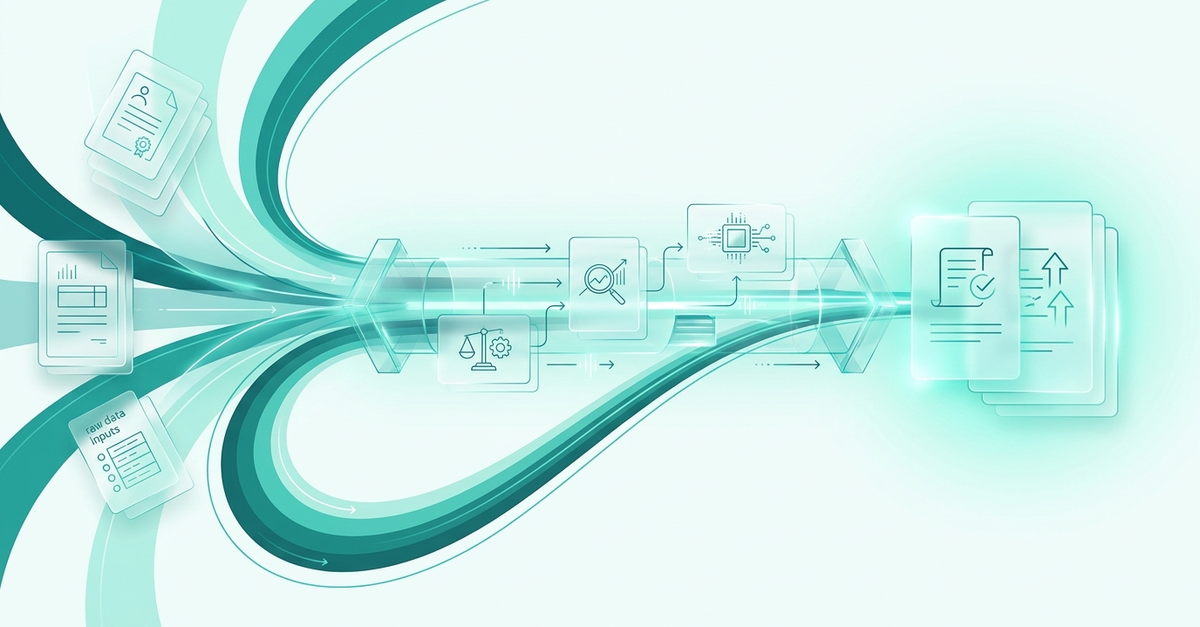
C&I loan automation, in 2026, means software that handles the mechanical layers of commercial and industrial underwriting and monitoring (document intake, financial spreading, tax-return analysis, global cash flow, draft credit memo assembly, and covenant testing), while leaving credit decisioning, exception handling, and final approval with a senior credit officer. It is not automated underwriting. It is analytical support that compresses the parts of the file that scale linearly with portfolio size, so the credit team can spend judgment time on the parts that do not.
The category is sloppy because vendors use it for very different things. Some "C&I loan automation" products are LOS workflow with rules-engine routing. Some are document-extraction tools bolted onto an existing spreader. Some are full underwriting platforms that read the package, build the spreads, and draft the memo. The buyer's job is to figure out which problem is actually being solved before signing anything.
This guide stays narrow on purpose. It defines C&I lending as commercial and industrial credit to operating businesses (working-capital lines, term loans, equipment financing, and asset-based lending) and walks through the automation layers that actually ship today. It is written for senior credit officers and chief credit officers at community and regional banks, not for the people who write "transform your lending" on a slide.
For the broader governance frame, the AI-Assisted Underwriting Playbook is the companion document. For the product view of the same workflow, see C&I loan underwriting software. This page focuses on the C&I-specific shape of the workflow.
What is C&I lending, and why does automation look different than for CRE or SBA?
C&I is commercial and industrial credit to operating businesses. The Federal Reserve H.8 release tracks it as its own loan category for a reason: the underwriting question is fundamentally different from real estate or consumer credit. The bank is lending against an operating business's cash flow and, often, against its working-capital assets (accounts receivable, inventory, equipment) rather than against a property or a personal credit profile.
In practice, C&I covers four product shapes that share an analytical engine but diverge sharply at the artifact level:
- Working-capital revolvers. Often structured as a borrowing-base line against eligible A/R and inventory, with monthly or quarterly compliance reporting and advance-rate mechanics.
- Term loans. Amortizing loans for general corporate purposes, refinancing, or acquisition, sized off DSCR or FCCR against operating cash flow.
- Equipment financing. Term debt secured by specific equipment, often with advance rates against new or used machinery values.
- Asset-based lending (ABL). Borrowing-base lines with formal eligibility tests, dilution reserves, and ongoing field exam requirements.
Why does automation look different here than on a CRE deal? Because the documents are different and the questions are different. A CRE file is a rent roll, an operating statement, an appraisal, and property-level DSCR. A C&I file is operating-company tax returns, audited or reviewed financial statements, interim financials, bank statements, A/R and A/P aging, debt schedules, and guarantor support. Generic "commercial loan automation" that was built around income-property logic does not handle a 1120-S with three years of trend, an A/R aging with 30/60/90/120 buckets, or a borrowing-base certificate the same way it handles a stabilized rent roll.
SBA is its own animal: same engine, but with 7(a) and 504 forms, eligibility tests, and SBA SOP requirements layered on top. If your shop runs all three, the right framing is one underwriting platform with C&I, CRE, and SBA templates configured separately, not three different vendors.
The four layers of C&I loan automation that actually work today
Strip the marketing language and there are four layers that automation handles defensibly on a real C&I file. The order matters: each layer feeds the next, and weaknesses upstream propagate downstream.
Layer 1. Document intake and classification
A typical C&I package arrives as a stack of mismatched PDFs: business returns across three years, a couple of guarantor 1040s, a financial statement that may or may not be audited, six to twelve months of bank statements, a debt schedule, an A/R aging, sometimes an organizational chart, and a personal financial statement that has not been updated in eighteen months. Step one is sorting that stack: identifying each document by form, year, and filing entity, matching guarantor returns to the right person, and flagging what is missing against a standard C&I file checklist before anyone starts spreading.
The unglamorous reality is that most of an underwriter's first hour on a new file is this work. Automation that classifies the package and surfaces gaps before the analyst opens a spreadsheet is where the workflow saves the most time.
Layer 2. Financial spreading and tax-return analysis
Once the package is classified, the spread is the next bottleneck. A clean Form 1040 takes roughly 20 to 30 minutes for a senior analyst to spread; a multi-entity Form 1065 with multiple Schedule K-1s and rental schedules can push past an hour. Three years of returns across an operating entity, a real-estate holding entity, and two guarantors is half a day before any analysis happens.
Modern AI financial spreading software reads each return, extracts the line items the bank's template needs, applies the bank's add-back policy uniformly across years and entities, and cites every figure back to the source page. The differentiator versus first-generation OCR spreading is not the extraction. It is the multi-document reasoning. A useful system reconciles a guarantor's Schedule E against the corresponding K-1 distributions and surfaces mismatches, instead of treating each document as an isolated extraction problem.
The full guide to this layer is what is loan spreading software. The short version: spreading is a reasoning task, not a typing task.
Layer 3. Global cash flow and guarantor analysis
C&I deals routinely involve multi-entity ownership: an operating company, a real-estate LLC that owns the building, a sister entity for a related business line, and one or two guarantors with Schedule E income from each. Global cash flow consolidates repayment capacity across that group, adjusted for ownership percentage, intercompany flows, and overlapping debt. Manual assembly on a multi-entity file routinely takes four to eight hours of senior-analyst time, with another 90 minutes burned tracing a three-tier K-1 structure when one entity owns a stake in the next.
The hard problem is not the formula. It is building the entity graph from the K-1s and entity returns, separating allocated income (Box 1 of a K-1) from cash actually distributed (Box 19), eliminating intercompany flows so the same dollar is not counted twice, and applying the bank's add-back policy consistently. AI-automated global cash flow analysis handles the cross-document reasoning and hands the underwriter a consolidated view with click-to-source citations on every figure. The deeper walkthrough is in the global cash flow automation guide.
Layer 4. Draft credit memo assembly
Once spreads, ratios, bank-statement cash flow, A/R detail, and global cash flow are in place, the credit memo is mostly assembly. A purpose-built AI credit memo generator for C&I drafts the borrower overview, deal structure, multi-year spreads with trend commentary, ratio analysis (DSCR, FCCR, leverage, liquidity, working capital), bank-statement cash flow, A/R and inventory detail, collateral coverage, guarantor analysis, global cash flow, and policy exception flags, with every figure cited back to the source page.
Manual prep on a standard C&I deal runs six to ten hours, longer for multi-entity structures. The automated draft compresses the assembly time and gives the underwriter a cited starting point to review and override, not a blank page to start from. The recommendation, the credit narrative, and the committee answer still come from the underwriter.
What still requires a senior credit officer?
Two layers should not be automated, and any vendor that says otherwise is selling something a community or regional bank cannot run defensibly through committee or an exam.
Credit decisioning
The approval call is not deterministic. It depends on the bank's appetite for the industry, its existing concentration, the relationship history, the strength of the secondary repayment source, the credibility of management, and whether the next twelve months in this borrower's market look like a tailwind or a headwind. None of that lives in the tax return. A model that scores a deal off financials alone is not making the credit decision the bank's policy actually requires.
The right pattern is the one the playbook describes: AI handles the analytical support, the underwriter writes the recommendation, and the credit committee decides. The artifact the AI produces should be a draft the credit officer can defend, not a verdict the credit officer is asked to ratify.
Exception handling and judgment add-backs
Some add-backs are easy: depreciation, amortization, non-recurring legal expense with a documented basis. Others are not: officer compensation that is materially above or below market, rent paid to a related-party landlord at a non-arms-length rate, distributions that look sustainable in the trailing year but were funded out of refinancing proceeds. Add-back judgment under deadline pressure is exactly where two analysts can produce two different cash flow views of the same borrower. The system should default to the bank's policy, but the override has to be visible, attributed, and reviewable. Same for policy exceptions: the system flags them, the credit officer decides whether to grant them.
Software handles
- Document classification and gap detection
- Line-item extraction from 1040, 1065, 1120, 1120-S, K-1, Schedule C, Schedule E
- Multi-year spreading and trend commentary
- DSCR, FCCR, leverage, liquidity, and working-capital calculations
- Bank-statement cash flow with NSF and average-balance analysis
- K-1 tracing and Schedule E reconciliation across entities
- Global cash flow consolidation with intercompany eliminations
- Draft memo assembly with source-page citations
Senior credit officer owns
- Final risk rating and approval recommendation
- Whether a one-time item is actually one-time
- Add-back overrides above the bank's default policy
- Treatment of related-party rent, comp, and distributions
- Concentration, industry, and relationship judgment
- Policy exceptions and the conditions attached to them
- The committee narrative
How does C&I loan automation handle covenants and portfolio monitoring after origination?
The same engine that spreads a deal at origination should run the post-booking work. The covenants written into the credit agreement at booking flow into automated covenant monitoring with the same calculation logic the bank used to underwrite the deal. The portfolio manager works exceptions instead of building tickler files in Outlook.
The standard C&I covenant set looks something like this:
- DSCR. Debt service coverage tested against trailing-twelve-month or fiscal-year cash flow.
- FCCR. Fixed charge coverage, broader than DSCR. Captures interest, principal, lease payments, and sometimes unfinanced capex.
- Leverage. Debt to EBITDA, sometimes senior debt to EBITDA on subordinated structures.
- Minimum tangible net worth and liquidity floors. Balance-sheet tests on the borrower or the guarantor, depending on the structure.
- ABL borrowing-base reporting. Monthly or weekly certificates with eligible A/R and inventory, advance rates applied, dilution and ineligibles deducted.
- Reporting covenants. Audited annuals within 90 to 120 days of fiscal year-end, interim financials quarterly, compliance certificates with each reporting package.
The useful version of this software does three things community-bank portfolio teams cannot do at scale by hand: it collects required documents on the cadence the loan agreement specifies, it calculates each covenant from the source documents instead of trusting borrower-reported numbers, and it produces a clean audit trail when a covenant is tested, breached, waived, or amended. Tools that only build a calendar and email the borrower do not solve the underlying calculation-drift problem.
Where does C&I underwriting actually break, and what does automation help with?
When C&I deals fall apart in committee or get flagged in an exam, the failure mode is usually one of a few specific patterns. Automation does not fix all of them. It does meaningfully narrow the ones that come from mechanical drift.
| Failure mode | What it looks like | What automation does |
|---|---|---|
| K-1 tracing across tiered ownership | A guarantor owns 40% of LLC A, which owns 60% of LLC B; analyst hand-traces the indirect 24% claim | Builds the entity graph from the K-1s and entity returns; surfaces unresolved ownership before sign-off |
| Multi-entity consolidation | Operating co plus real-estate holding co plus sister entity, each spread separately, never reconciled | Spreads each entity, eliminates intercompany flows, consolidates with the bank's add-back policy |
| Add-back drift across analysts | Two analysts treat depreciation, owner comp, and one-time items differently under deadline pressure | Applies bank-policy defaults uniformly; logs every override with attribution |
| Allocated income vs. distributed cash | K-1 Box 1 income added to repayment capacity even when no cash was actually distributed | Keeps allocation and distribution treatment explicit and reviewable |
| Schedule E to K-1 mismatches | Personal return shows pass-through income that does not reconcile to the supporting K-1s | Cross-checks Schedule E against K-1 support automatically and flags the variance |
| ABL borrowing-base drift | Borrower-reported eligible A/R and inventory diverge from what the bank would calculate from the aging | Recalculates the borrowing base from the source documents and flags variance from the borrower certificate |
None of these are exotic. They are the recurring failure modes that show up in exam findings and in trailing-twelve-month loss postmortems. The point of C&I loan automation is not to replace credit judgment. It is to remove the mechanical drift that hides credit problems until they are too late to manage.
What do examiners expect under the revised 2026 model risk management guidance?
On April 17, 2026, the OCC, Federal Reserve, and FDIC issued revised interagency guidance on model risk management. The Federal Reserve issued it as SR 26-2, and the OCC issued it as OCC Bulletin 2026-13. The new guidance is most directly relevant to banking organizations with over $30 billion in total assets, but it remains relevant to smaller institutions with significant model exposure, and most community-bank examination teams will read it as the current articulation of supervisory expectations.
For C&I loan automation, the practical translation is unchanged from what the prior guidance asked for and what shipped Aloan content has emphasized for over a year:
- Inventory. The bank knows where AI is being used in the credit workflow.
- Conceptual soundness. The bank can explain what the system does, what data it uses, and where it is reliable.
- Validation, including for vendor models. The bank tests the system on its own files and tracks override rates and error patterns.
- Ongoing monitoring. Performance is tracked over time, not just at vendor selection.
- Audit trail. Every analytical output ties back to a source document and a specific page; every override is timestamped and attributed.
The full breakdown of what an exam team is likely to ask is in the examiner readiness guide. The short version: a C&I automation rollout that cannot reproduce the math behind a credit memo number is not ready for an exam, regardless of which vendor logo is on the screen.
How should a C&I shop sequence the rollout?
Spreading first, not memos first. The financial spread is the upstream input to every other artifact in the workflow. If the spread is wrong, the ratios are wrong, the global cash flow is wrong, and the cited credit memo is a confidently wrong document. Banks that try to automate the memo before the spread end up with cited memos built on shaky numbers, and those are harder to defend in committee than an honestly hand-built memo, because the source citations make the numbers look more authoritative than they are.
A defensible sequence looks like this:
- Define the bank's target artifact. What does a correct C&I spread look like at this institution? Which add-backs are policy-approved? How is related-party rent treated? Without that anchor, the software produces an argument generator instead of a time saver.
- Validate spreading on real files first. Multi-entity 1065s, ABL borrowers with messy A/R agings, the file your best analyst muttered through last quarter. Clean 1040s flatter weak systems and teach nothing.
- Layer in global cash flow and guarantor analysis. Once spreads are reliable, the consolidation step is where the day-saving compounds.
- Add draft credit memo assembly. Only after the upstream layers reconcile, because the memo cites the upstream output.
- Carry the same logic into covenant monitoring. The covenants in the credit memo flow into the post-booking workflow with the same calculation engine.
- Track override rates by type. Where the underwriters are overriding the system, you have a calibration question. Where they are not, the system is doing the work it should.
Operating benchmark: if your analysts are still exporting entity-level spreads into Excel to consolidate the global view by hand, you do not have C&I loan automation. You have partial automation with manual rollup on top, which is exactly the workflow that hides drift between analysts.
Frequently asked questions about C&I loan automation
What is C&I loan automation?
C&I loan automation is the use of software to handle the mechanical work in commercial and industrial underwriting and monitoring: document classification, financial spreading, tax-return analysis, global cash flow consolidation, draft credit memo assembly, and covenant testing. It does not mean automated credit decisioning. The senior credit officer still owns approval, exception handling, and the final risk rating.
How is C&I loan automation different from CRE or SBA automation?
C&I deals lean on operating-company financials, bank statements, A/R and A/P aging, and borrowing-base mechanics for revolvers. CRE leans on rent rolls, NOI, and property-level DSCR. SBA layers in 7(a) and 504 forms and SBA-specific eligibility. The underlying engines (extraction, spreading, K-1 tracing) are shared, but the templates, ratios, and policy rules differ enough that a generic workflow misses the point of each.
What can automation handle today and what still requires a human?
Automation reliably handles document intake and classification, line-item extraction from 1040, 1065, 1120, and 1120-S returns, financial spreading, K-1 and Schedule E tracing across multi-entity structures, global cash flow consolidation with intercompany eliminations, and a draft credit memo with source-document citations. Humans still own credit decisioning, add-back judgment on borderline items, exception handling, and the final recommendation to committee.
Does C&I loan automation include covenant monitoring?
It should. The covenant set written into the credit agreement at booking should flow into the monitoring system with the same calculation logic the bank used to underwrite the deal. Common C&I covenants include DSCR, FCCR, debt to EBITDA leverage, minimum tangible net worth, and liquidity floors. ABL deals add borrowing-base reporting against eligible A/R and inventory.
Where should a bank start with C&I loan automation?
Spreading first, not memos first. The financial spread is the upstream input to every other artifact. Once spreads are reliable on real multi-entity files, layer in global cash flow, then draft credit memo assembly, then ongoing covenant monitoring. Banks that try to automate the memo before the spread end up with cited memos built on shaky numbers.
How this works in practice: Aloan is built around the C&I files that usually break generic automation: full operating-company packages, multi-entity ownership, K-1 tracing, ABL borrowing-base mechanics, and source-document support on every analytical output. The goal is not to remove the credit officer. It is to give the credit officer a faster, traceable workflow with clear override control. To pressure-test it on one of your own files, get a demo.
Go deeper: For the broader buyer's frame, see the best commercial lending software guide. For audience-specific patterns, see community banks and regional banks. For governance and rollout sequencing, the AI-Assisted Underwriting Playbook remains the source.