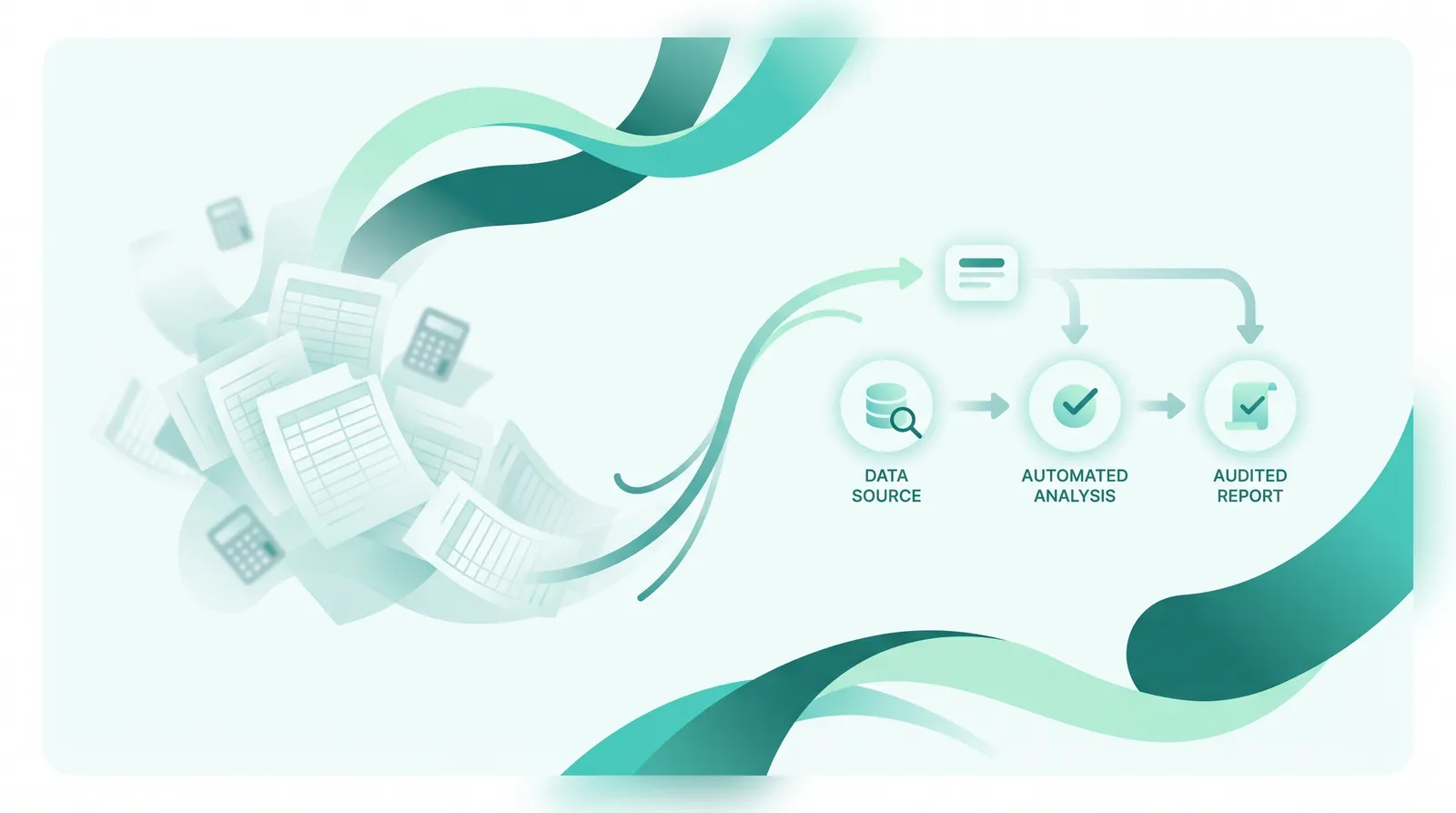
Manual spreading is still the default competitor in commercial lending. For many banks, that means an analyst opening a PDF packet on one screen, an internal Excel model on the other, and typing line items into a spread one cell at a time. Aloan is the AI-native commercial loan origination system, and spreading is one step of the file it runs. It changes the labor mix, not the credit decision: it automates classification, extraction, and citation so the analyst reviews the work instead of rebuilding the packet by hand.
That distinction matters. The decision is not spreadsheet versus no human. The real choice is whether skilled credit talent should spend the day tracing K-1s, reconciling continuation schedules, and rekeying depreciation add-backs, or whether software should handle the mechanics while the analyst handles judgment.
If you need the broader category frame first, read the guide to loan spreading software. If you want the short answer, it is this: manual spreadsheet spreading is familiar and controllable, but it is a throughput bottleneck once a commercial team starts carrying real multi-entity volume.
What does manual spreading actually look like in a commercial lending shop?
The manual workflow is familiar to every credit team. A borrower sends a packet with three years of returns, financial statements, maybe rent rolls, maybe a personal financial statement, often all combined into a single PDF. The analyst sorts documents by entity and year, identifies the form type, opens the bank's spread template, then starts mapping values line by line.
On a simple file, that is manageable. On a commercial file with a personal 1040, two 1065s, one 1120-S, and K-1s that feed back into Schedule E, the work becomes mostly reconciliation. The analyst is not thinking about structure first. The analyst is hunting for the right page, checking whether the continuation statement changes the base number, and making sure the same item is treated consistently across entities.
The tax return spreading guide walks through that workflow in detail. It is defensible work, but it is still keystroke-heavy work.
Where does time get lost in spreadsheet spreading?
Time disappears in four places.
- Document sorting. Analysts spend time just figuring out what belongs to which entity and tax year.
- Line-item transcription. Every revenue, expense, depreciation, interest, and distribution line has to be moved from the source document into the template.
- Cross-document reconciliation. K-1 amounts, Schedule E entries, and entity-level returns have to tie out across the packet.
- Exception handling. Amended returns, missing schedules, odd labels, and one-time items force the analyst out of the normal path.
The playbook already makes the larger point: commercial underwriting teams spend most of their time on data extraction, not analysis. Manual spreading is the center of that problem because every downstream artifact depends on the spread being right. That is why banks often feel buried even when they are not adding more policy steps. The spreadsheet work is swallowing the day.
| Workflow step | Manual spreadsheet spreading | Aloan |
|---|---|---|
| Packet intake | Analyst sorts forms, entities, and years by hand | Documents are classified automatically for analyst review |
| Spread population | Numbers keyed into Excel or a spreading template cell by cell | Spread is populated from extracted source data with citations |
| K-1 tracing | Senior analyst reconciles ownership flows manually | Entity relationships are assembled first, then reviewed by the analyst |
| Audit trail | Depends on analyst notes and the spreadsheet's integrity | Every extracted number links back to the source page |
| Human role | Typing, checking, adjusting, analyzing | Reviewing, adjusting, interpreting, deciding |
What errors show up most often in manual spreading?
Manual spreading fails quietly. Nobody notices the problem at the moment the analyst types the value. The problem appears later, when a ratio looks off, a global cash flow does not reconcile, or credit review asks why an add-back was handled differently this year.
- Transcription errors. One mistyped value can move leverage, DSCR, or debt service calculations downstream.
- Missed continuation schedules. Commercial tax returns often push key detail into attached statements that do not look like the main form.
- Inconsistent add-backs. Different analysts treat depreciation, owner compensation, rent to related parties, and one-time items differently.
- Broken K-1 tracing. The amount on the K-1, the entity return, and the owner's Schedule E do not always line up cleanly unless someone traces them carefully.
- Stale spreadsheet logic. Internal models survive for years, and formula drift is real when templates are copied from file to file.
That is the core tradeoff versus financial spreading software. Manual processes feel controllable because a human touched every field. But the error surface is larger precisely because a human touched every field.
How does Aloan differ from Excel-based spreading?
Aloan does not automate the credit decision. It does the document work that happens before the decision, as one step of the whole file: the software reads the packet, organizes the source material, extracts the values needed for the spread, checks the deal against your credit policy, drafts the memo, and preserves source-page traceability so the analyst can verify what happened.
That shifts the analyst from operator to reviewer. Instead of spending the first hour building the spread, the analyst starts with a populated view and focuses on exceptions, policy treatment, and what the numbers mean. That same sequencing is why the AI-assisted underwriting playbook treats spreading as the right first automation step. Extraction is easier to validate than memo generation, and the output becomes the base for everything that follows.
| Dimension | Manual spreading / Excel | Aloan |
|---|---|---|
| Speed on multi-entity files | Hours of analyst time | Minutes of processing plus analyst review |
| Auditability | Depends on analyst notes, template discipline, and version control | Source-page citations are built into the workflow |
| Onboarding cost | Low software cost, high training and analyst time cost | Software implementation, lower recurring manual labor |
| Consistency | Varies by analyst and template hygiene | Consistent extraction path with logged overrides |
| Best human contribution | Everything, including data entry | Judgment, exception review, and credit recommendation |
When is manual spreading still the right answer?
Manual spreading is still a reasonable choice for very low volume teams, unusually simple file mixes, or banks that are not yet prepared to standardize their spreading policy. If the portfolio is small, the templates are stable, and a senior analyst reviews nearly every deal, the spreadsheet can hold for longer than vendors like to admit.
The problem is that those conditions rarely last. Once a bank wants faster turnaround, more consistency across analysts, or better handling of multi-entity tax work, the spreadsheet stops being a cheap tool and starts being an operating constraint. That is also where adjacent comparisons such as Aloan vs FlashSpread and Aloan vs Sageworks become relevant, because the next step after Excel is either a spreading point solution or an AI-native commercial LOS that does the spreading as one step of the whole file.
What should the human analyst still own?
The human should still own the parts of underwriting that require judgment.
- Interpreting whether an add-back is sustainable
- Assessing guarantor support and borrower behavior
- Applying policy and structure judgment
- Writing the recommendation and defending it to credit committee
That is why the practical comparison is not analyst versus software. It is analyst judgment versus analyst keystrokes. Aloan is strongest when a bank wants to protect the first and remove as much of the second as possible. If you want the broader operational framing, the AI underwriting use cases guide and the commercial lending glossary are the next logical reads.
FAQ: Aloan vs manual spreading
What is the difference between Aloan and manual spreading in commercial lending?
Manual spreading means an analyst reads borrower tax returns and financial statements, then keys values into an Excel model or spreading template by hand. Aloan is the AI-native commercial loan origination system; it keeps the analyst in control and automates document classification, extraction, spread population, and source citations so the analyst can review and apply judgment instead of spending hours on transcription.
Is manual spreadsheet spreading still common at community banks?
Yes. Many community banks and commercial lending teams still rely on internal Excel models, LOS-bundled templates, or legacy spreading tools for tax return and financial statement spreading. That workflow is familiar and defensible, but it creates a throughput bottleneck because every file still depends on manual data entry and reconciliation.
What are the biggest risks in manual tax return spreading?
The biggest risks are transcription mistakes, inconsistent add-back treatment, missed continuation schedules, broken K-1 tracing across entities, and stale spreadsheet logic that survives from one analyst to the next. On a multi-entity commercial credit, one small mistake can carry through the spread, global cash flow, and credit memo.
Does Aloan replace the underwriter?
No. The analyst or underwriter still owns credit judgment, policy interpretation, structure, and recommendation. Aloan handles the extraction and organization work, then preserves an audit trail with source-page citations so the human reviewer can verify the numbers and make the decision.
When does a bank outgrow manual spreading?
A bank usually outgrows manual spreading when turnaround time starts slipping, senior analysts spend more time typing than analyzing, and multi-entity tax return files pile up faster than the team can clear them. That is usually the moment when spreadsheet discipline stops being enough and throughput becomes the real constraint.
Keep reading
Compare hub. Browse the full commercial lending compare hub for platform and point-solution comparisons.
Category context. Read financial spreading software and best financial spreading software if you are evaluating the buying landscape.
Related comparisons. If your team is choosing between a spreadsheet and the next step up, compare Aloan vs FlashSpread and Aloan vs Abrigo.
Workflow strategy. The AI-Assisted Underwriting Playbook, demo page, and cascading LLC ownership post show where manual work breaks down fastest.