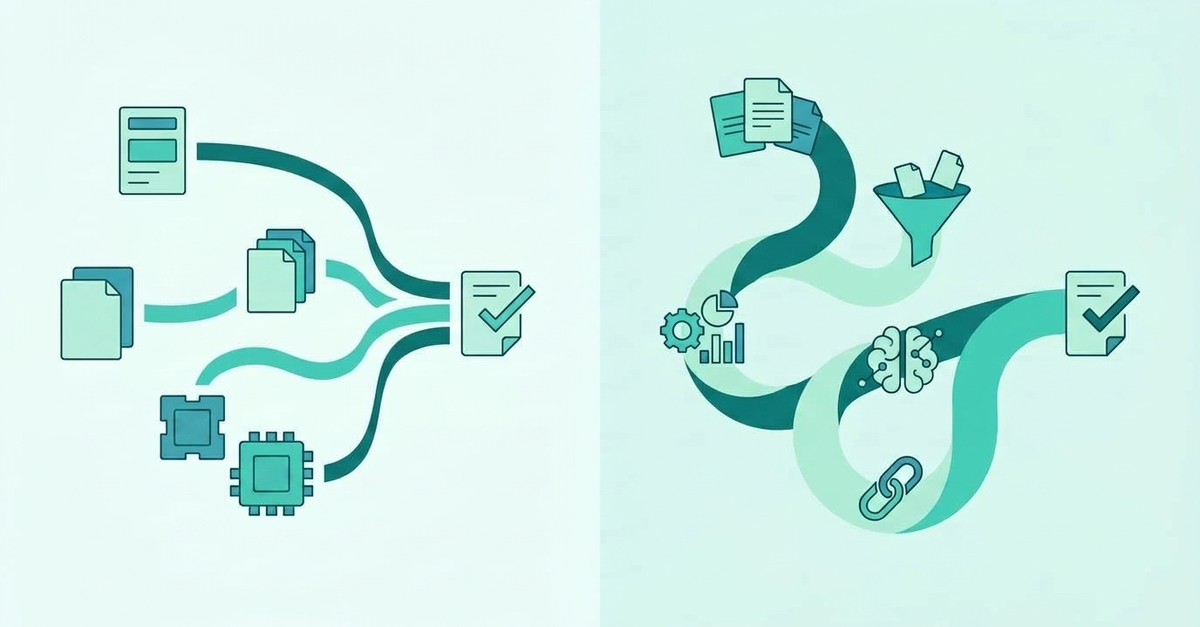
Side-by-side comparison
The two products are easy to confuse because both market AI credit memo generation. The substance underneath looks different once a US commercial credit file is on the table — tax returns, K-1s, Schedule E rentals, multi-entity guarantors, and a bank examiner expecting to reconstruct how the analysis was built.
The closest sibling comparisons are Aloan vs Ocrolus on the IDP-only side of the question, and Aloan vs Lama AI on the newer agentic-LOS side. GLIB sits one step closer to underwriting than Ocrolus because it also markets memo generation and risk analysis modules on top of its analyzer stack, and one step closer to extraction than Lama AI because its product center is still the analyzer layer rather than the SMB origination network.
| Area | Aloan | GLIB.ai |
|---|---|---|
| Headquarters | United States | Ahmedabad, Gujarat, India (Cygnet Digital company) |
| Primary buyer profile | US community banks, credit unions, regional banks, non-bank commercial lenders | Banks and financial institutions across India, USA, Europe, MENA |
| Product category | AI-native commercial LOS; run it as your commercial LOS, or alongside the one you already have | Intelligent document processing analyzers with lending modules |
| Core products | Spreading, global cash flow, cited memo generation, covenant monitoring, risk flagging | Bank Statement Analyzer, Financial Statement Analyzer, Invoice Analyzer |
| US tax return coverage (1040, 1120, 1120S, 1065, K-1, Schedule E) | Native end-to-end with K-1 reconciliation | Not publicly marketed; product center is bank statements, financial statements, invoices |
| Cross-document reasoning | Multi-entity guarantor reconciliation, ownership graph, K-1 tracing, global cash flow, add-back policy application | Analyzer-level extraction and explainable decisioning; multi-entity US commercial file reasoning not the marketed wedge |
| Credit memo output | Drafted from the same workflow that built the spread; every figure linked to source page | Templated draft built on extracted spreads, ratios, and risk analysis with human review |
| Auditability | Page-level source citations on every spread and memo number; override history attached to the credit file | Explainable AI and decision traceability at the platform level |
| Regulatory framing | Built for US bank exams: SR 11-7, SR 26-2 / OCC 2026-13, OCC 2025-26 community-bank proportionality | Cross-market governance language; not specifically aligned to US bank-examiner expectations |
| Multilingual / multi-currency document support | English, USD; built around US lending instruments | Publicly emphasized — multiple languages and cross-market deployments |
| Deployment options | US-hosted SaaS; run as the LOS or alongside the one you have | APIs and modular analyzers; on-prem option marketed |
| Implementation time | Two to four weeks, no LOS migration | Rapid deployment in weeks, per public banking-solution materials |
| Coexistence with existing systems | Runs as the commercial LOS, or alongside an incumbent such as nCino, a Salesforce build, Baker Hill, MeridianLink or LaserPro; integration via REST API and webhooks, scoped per bank | API-level integration into LOS, LMS, core, and bureau systems |
IDP analyzers vs underwriting workflow
GLIB.ai's strength is the analyzer layer. The Bank Statement Analyzer ingests statements across multiple banks and currencies, runs income verification and tampering checks, and produces structured cash-flow output. The Financial Statement Analyzer extracts data from balance sheets and income statements and runs ratio analysis. That work matters and it solves a real bottleneck — extraction at scale across heterogeneous document formats.
The work a US community-bank credit analyst does after extraction looks different. Schedule E rentals have to roll up into personal cash flow. K-1 income has to tie back to the guarantor's 1040 and the 1065 it came from. Multi-entity borrowing groups have to consolidate without double counting. The bank's add-back policy has to be applied consistently across files. The credit memo has to land in the bank's format with every number defensible to a credit officer and a regulator. None of that is an extraction problem.
Aloan was designed around the second half of that workflow. The AI-Assisted Underwriting Playbook walks through the workflow controls, exception handling, and validation that build on extraction quality. Extraction is the entry point, not the product.
Credit memo depth on a real US commercial file
GLIB.ai markets a configurable memo generator with templates, human review, and support for both public and private company financials. For an annual review built from clean financial statements, that workflow can save real time over a manual memo process.
The question is what the memo assumes about the file underneath. A typical US commercial credit file is not a clean financial statement. It is tax returns at the operating company, tax returns at the holding company, K-1s flowing to multiple guarantors, Schedule E rentals at the personal level, bank statements covering deposit verification, and rent rolls on the CRE side. The IRS Form 1065 instructions describe how each partner receives a Schedule K-1 with that partner's share of income, deductions, and credits — and an underwriter has to tie those K-1s into guarantor cash flow, ownership structure, and debt-service support across the whole borrowing group before a memo can land.
Aloan's memo is downstream of that whole reconciliation. The same workflow that pulls the spreads, traces K-1s into personal cash flow, and consolidates the borrowing group writes the narrative. Every figure in the draft memo links to the page in the source document it came from, which is the level of citation a US bank examiner expects when they reopen a file later.
| Demo request | What it surfaces |
|---|---|
| Bring a multi-entity 1065 with K-1s flowing to two guarantors | Whether memo and cash flow hold up once ownership and entity structure stop being flat. |
| Add Schedule E rentals at the personal level | Whether rental income reconciles cleanly into personal and global cash flow. |
| Apply your bank's add-back policy live | Whether the memo reflects the bank's credit policy or a generic template. |
| Click any memo number back to its source page | How close the citation sits to the document a US examiner reopens later. |
| Override one spread line and inspect history | Whether the override path stays visible to the next reviewer. |
Auditability and US examiner readiness
GLIB.ai markets explainable AI for underwriting, decision traceability, and integrations that keep the analysis inside the bank's existing lending systems. Those are real controls and any bank evaluating either product should expect them.
The difference is how close the proof sits to the credit file a US bank examiner actually opens. Under the April 2026 revised interagency guidance in SR 26-2 and OCC Bulletin 2026-13, with community-bank proportionality in OCC Bulletin 2025-26, the exam team wants to reconstruct how the bank moved from raw source documents to a credit decision. A page-citation that takes the reviewer directly back to the line on the source document is a different kind of evidence than a platform-level decision log.
Aloan was designed against that specific audit pattern. Every figure in a spread or memo cites the source page. Override history stays attached to the credit file. The examiner readiness guide walks through how that maps to the questions OCC, FDIC, NCUA, and state examiners are asking US banks today, and the AI underwriting governance guide covers the supporting model inventory, decision-authority matrix, and validation cadence.
Embedding analyzers vs adopting a commercial LOS
GLIB.ai's public materials lean hard into embeddability. The analyzers connect to core banking systems, LOS platforms, LMS platforms, and bureau workflows through APIs, and the company markets on-prem deployment as an option for institutions with strict residency requirements. A bank that already knows how it wants underwriting to run, and just wants to upgrade narrow layers like bank statement parsing or financial statement extraction, gets real value from that modularity.
Aloan changes more of the working surface after documents arrive. It is a commercial LOS in its own right and owns the analyst experience from upload to routed memo: run it as your commercial LOS, or alongside the one you already have. The value is larger when the bottleneck is manual underwriting throughput on US commercial files rather than document ingestion alone, and when the credit team wants the same product to handle spreading, global cash flow, memo drafting, and covenant monitoring.
The decision lands on what the buyer is trying to fix. A bank looking to upgrade discrete document-processing steps inside an existing process leans toward GLIB. A US credit team trying to compress the spread-to-memo cycle on multi-entity commercial files, with citations attached and an examiner-defensible audit trail, leans toward Aloan.
When GLIB.ai is the better fit
GLIB.ai earns the look when most of these conditions apply at the same time:
- The procurement is IDP-led. The team wants document-processing components, not a broader underwriting workflow change.
- Bank statement analysis is the wedge. Multi-account analysis, income verification, spend analysis, tampering checks, and early warning signals are central to the buying case.
- Multilingual or cross-market document handling matters. GLIB.ai publicly markets multilingual extraction and operates across India, the USA, Europe, and MENA, which most US-only underwriting vendors do not.
- On-prem deployment is required. GLIB.ai markets on-prem options that can fit institutions with stricter residency or infrastructure constraints.
- The institution wants to keep its current underwriting process. Analyzers slot in via API and leave the rest of the workflow intact.
Outside that profile — particularly for a US community bank or credit union doing C&I, CRE, ABL, or SBA underwriting on tax-return-driven files — GLIB.ai is being asked to do work outside the center of gravity its product was built around.
Bottom line
GLIB.ai is a capable IDP analyzer stack out of Ahmedabad, India, with credible memo and underwriting modules layered on top — well-suited to multi-region banking customers and document-processing-led procurements. Aloan is the better fit when the buyer is a US community bank, credit union, or regional bank underwriting commercial credit on tax returns and K-1s, expects a cited memo as the output of one workflow, and is being reviewed under US bank-examiner expectations.
Frequently asked questions
What is the difference between Aloan and GLIB.ai?
Aloan is the AI-native commercial loan origination system, built for US community banks, credit unions, and regional banks. It spreads US tax returns and K-1s, reconciles Schedule E rentals into global cash flow, applies the bank's add-back policy, drafts source-cited credit memos, and tracks covenants after booking. GLIB.ai (Genesis Artificial Intelligence, founded 2013 in Ahmedabad, India; majority acquired by Cygnet Digital in March 2022) sells Bank Statement Analyzer, Financial Statement Analyzer, and Invoice Analyzer modules with lending add-ons, designed to plug into an existing underwriting process across India, the USA, Europe, and MENA. The short version: GLIB.ai sells analyzers a bank can integrate; Aloan is the LOS that does the credit work between document intake and committee, run as your commercial LOS or alongside the one you already have.
Where is GLIB.ai based and who owns it?
GLIB.ai (Genesis Artificial Intelligence) was founded in 2013 in Ahmedabad, Gujarat, India. Its public materials describe it as one of India's first AI/ML companies, and a majority stake was acquired by Cygnet Digital in March 2022. The company markets serving banks and financial institutions across India, the USA, Europe, and MENA. Aloan is US-based and built specifically for community banks, credit unions, and regional banks underwriting commercial credit under US bank-examiner expectations.
Does GLIB.ai handle US tax returns, K-1 reconciliation, and Schedule E?
GLIB.ai's public product materials emphasize bank statements, financial statements, and invoices — not US-specific tax-return spreading. Schedule K-1 reconciliation across multi-entity borrowing groups, Schedule E rental rollups into personal cash flow, and 1040/1120/1120S/1065 coverage are not features GLIB publicly markets. Aloan covers the full US tax-return set natively, reconciles K-1s into personal and global cash flow, and outputs a traditional commercial spread (UCA cash flow, EBITDA reconciliation, DSCR, debt yield).
When is GLIB.ai the better fit than Aloan?
GLIB.ai is the better fit when bank statement analysis or multilingual document intake is the procurement wedge, when on-prem deployment or India/MENA/Europe data residency is required, or when the institution wants embeddable analyzer APIs to plug into an existing underwriting process it intends to keep. Aloan is the better fit when the bottleneck is US commercial underwriting throughput, when tax-return depth and examiner-ready audit trails matter, and when the credit team wants one workflow from file intake to committee memo.
How do examiner-ready audit trails compare?
GLIB.ai markets explainable AI and decision traceability at the platform level. Aloan centers the audit story on the artifact a US examiner actually opens: every figure in the spread and memo cites the source page, and override history stays attached to the credit file. For OCC, FDIC, NCUA, or state exam cycles operating under SR 11-7 / SR 26-2 model risk expectations, that source-linked file reconstruction is the difference between auditable and traceable in marketing copy.
How do deployment and data residency compare?
GLIB.ai publicly emphasizes APIs, modular analyzers, multilingual document handling, and on-prem deployment options — useful for institutions with strict residency or infrastructure constraints, particularly outside the US. Aloan deploys US-hosted in two to four weeks, as your commercial LOS or alongside the one you already have, with no Salesforce dependency. Aloan does not offer on-prem.